News
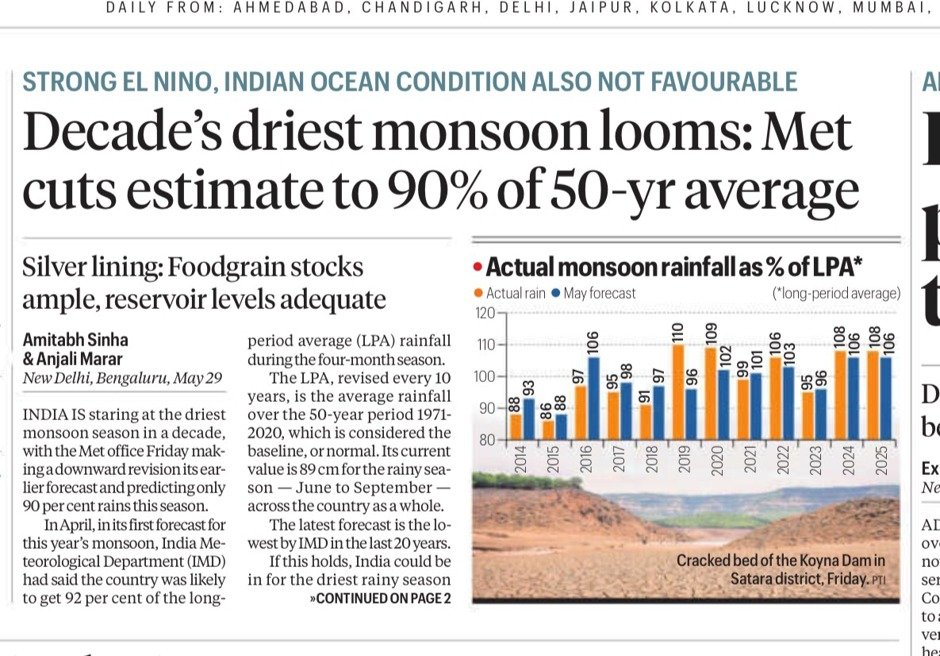
- IMD REVISED FORECAST 90% of LPA — lowest IMD forecast in 20 years
- APRIL (FIRST) FORECAST 92% of LPA — later revised downward in May
- LPA VALUE 89 cm For June–September season (base: 1971–2020)
Cause - Strong El Niño.
- El Niño (Spanish: "The Little Boy / Christ Child") — named so because it typically appears around Christmas off the coast of Peru/Ecuador.
- Under normal conditions in the Pacific Ocean: Trade winds blow from east → west along the equator, pushing warm surface water towards the western Pacific (near Australia/Indonesia). This causes upwelling of cold water off the South American coast.
- During El Niño: Trade winds weaken or even reverse. Warm water "sloshes back" eastward towards the central and eastern Pacific. Sea Surface Temperatures (SSTs) in the central/eastern Pacific rise abnormally (by 0.5°C–2°C or more above average). This disrupts global atmospheric circulation patterns.
ENSO = El Niño-Southern Oscillation. "Southern Oscillation" refers to the seesaw in atmospheric pressure between the eastern Pacific (Tahiti) and western Pacific (Darwin, Australia). Measured by the Southern Oscillation Index (SOI):
- Negative SOI → El Niño;
- Positive SOI → La Niña.
MECHANISM
- Warm pool shifts east → convection (rising warm moist air) shifts from western Pacific/Indian Ocean towards central Pacific.
- This suppresses convection over the Indian Ocean — less evaporation, less moisture.
- The cross-equatorial flow of the Somali Jet (low-level jet stream) that feeds SW monsoon weakens.
- The upper-level easterly jet over India weakens → reduces the pressure gradient that drives monsoon winds.
- Net result: delayed onset, spatial gaps in rainfall, below-normal seasonal total.
EL NIÑO AND INDIAN AGRICULTURE — IMPLICATIONS
- Kharif crops at risk: Rice, maize, pulses, oilseeds, cotton, sugarcane — all depend heavily on SW monsoon. Deficient rainfall → lower Kharif output.
- Rabi can be partially compensated: If reservoir levels and groundwater are adequate from pre-monsoon rains, rabi crops (wheat, mustard, gram) may be insulated.
- 2025 silver lining (from article): Foodgrain buffer stocks are ample and reservoir levels are currently adequate — reducing immediate food security risk even if monsoon is below normal.
- Price inflation risk: Deficient monsoon → poor Kharif harvest → food inflation → pressure on RBI monetary policy.