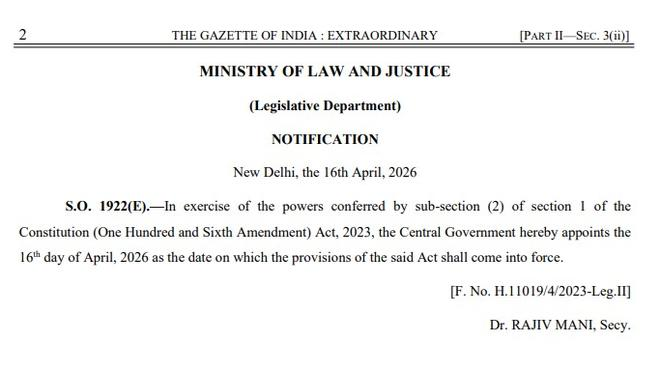
The Central Government issued a notification on April 16, 2026,implementing the Women's Reservation Act 2023 (Nari Shakti Vandan Adhiniyam 2023).
Key Points:-
Signed by President Draupadi Murmu on September 28, 2023. ◦ According to the gazette notification of September 28, 2023, "It shall come into force on such date as the Central Government may, by notification in the Official Gazette, determine."
106th Constitutional Amendment Act.
Provision for reserving one-third of all seats for women in the Lok Sabha, State Legislative Assemblies, and the Legislative Assembly of the National Capital Territory of Delhi, as far as possible.
Also applicable to seats reserved for Scheduled Castes and Scheduled Tribes in the Lok Sabha and State Legislative Assemblies.
Article Provision for women's reservation in the Central Legislature by Article 330(A), in the State Legislature by Article 332(A), and in the National Capital Territory of Delhi by constitutional amendment to Article 239AA(2)(b).
Article 334A ◦ Reservation will be provided for a period of 15 years. However, it will continue until such date as may be determined by an Act of Parliament. ◦ Reservation will take effect after the publication of the census conducted after the commencement of the Act. ◦ Delimitation will be carried out to reserve seats for women based on the census.
After each delimitation, seats reserved for women will be rotated, as may be determined by an Act of Parliament
Amendments to the Nari Shakti Vandan Adhiniyam 2023:-
According to the provisions of the Act, the benefits of women's reservation will be available after the 2027 Census and the delimitation based on it.
These three bills were introduced to increase the size of the LokSabha (from 543 to 850), enable delimitation based on the 2011 Census, and enable reservation for women based on this delimitation.
To expedite the implementation of the reservation, the Government of India convened a three-day special session (extension of budget session) of Parliament from April 16 to 18, 2026, and introduced three bills: ◦ The Constitution (131st Amendment) Bill, 2026 ◦ The Delimitation Bill, 2026 ◦ The Union Territories Laws (Amendment) Bill, 2026
The Constitution (131st Amendment) Bill, 2026 failed to secure the required two-thirds majority (supported by 326 MPs) in the Lok Sabha. ◦ Following the defeat, thegovernment withdrew the Delimitation Bill, 2026 and the Union Territories Laws (Amendment) Bill, 2026
Impact of the Nari Shakti Vandan Adhiniyam 2023:-
Increased political participation of women
Promoting a gender perspective in policymaking
Increased empowerment and selfconfidence of women.
Democracy will become more inclusive and representative
Play a key role in achieving Sustainable Development Goal (SDG) 5 (Gender Equality).
Challenges:-
Delay in implementation (dependence on census and delimitation).
Lack of separate reservation for OBC women.
Threat of proxy representation (actual control by men).
Rotation of seats may impact continuity and development work.
Critical Perspective:-
Increasing numbers alone is not enough; ensuring quality participation is also essential
Improving internal democracy and ticket distribution within political parties is essential.
Capacity building for women and removing financial barriers are essential.
Conclusion:-
The Nari Shakti Vandan Adhiniyam 2023 is a historic step towards makingIndian democracy moreinclusive, equitable, andgender- balanced.
Its real benefits can only be ensured through its effective implementation and social awareness.