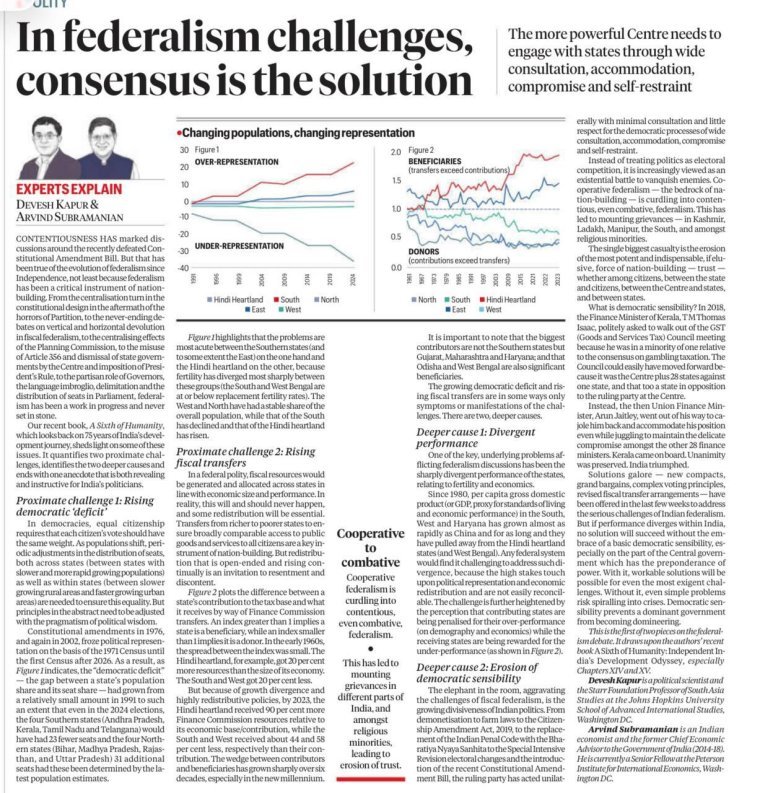
1. The Core Issue: Cooperative vs. Combative Federalism
- Federalism is a critical instrument of nation-building.
- However, politics is increasingly viewed as an "existential battle" rather than electoral competition, causing cooperative federalism to curdle into contentious, combative federalism.
- This has led to an erosion of trust between the Centre and states, and among citizens, fueling grievances in various regions (e.g., the South, border states, and among minorities).
2. Proximate Challenges in Federalism
- The authors identify two immediate manifestations of federal tension:
A. Rising Democratic 'Deficit' (Political Representation)
- The Problem: The gap between a state’s population share and its parliamentary seat share is widening.
- Historical Context: Constitutional amendments in 1976 and 2002 froze political representation based on the 1971 Census until the first Census after 2026.
- Diverging Demographics: Southern and Western states have fertility rates at or below replacement levels, while Northern and Eastern states have growing populations.
- Impact: If seats were reallocated based on current population estimates, four Southern states (AP, Kerala, TN, Telangana) would lose 23 seats, while four Northern states (Bihar, MP, Rajasthan, UP) would gain 31 seats. The South is structurally under-represented.
B. Rising Fiscal Transfers (Economic Redistribution)
- The Problem: The wedge between what states contribute to the tax base (Donors) and what they receive via Finance Commission transfers (Beneficiaries) has grown sharply.
- Data Shift: Early 1960s: The spread was small. The Hindi heartland received 20% more than its contribution, while the South/West received 20% less.
- By 2023: The Hindi heartland receives 90% more than its contribution, while the South and West receive 44% and 58% less, respectively.
- Discontent: While redistribution from richer to poorer states is essential for nation-building, open-ended and constantly rising redistribution breeds resentment among contributing states.
3. Deeper Root Causes
Behind these proximate challenges lie two fundamental issues:
A. Divergent Performance of States
- Since 1980, there has been a sharp divergence in per capita gross domestic product (proxy for standard of living) between the South/West and the Hindi heartland.
- The Penalty of Success: Contributing states (South/West) feel they are being penalized politically and financially for their over-performance in controlling demographics and boosting economics, while receiving states are rewarded for under-performance.
B. Erosion of Democratic Sensibility
- There is a growing divisiveness in Indian politics characterized by unilateral actions by the ruling party at the Centre.
- Policies and laws (e.g., Demonetisation, Farm Laws, CAA, new criminal codes like BNS) have often been enacted with minimal consultation, accommodation, or respect for democratic processes.
4.Institutional & Political Friction
- The Partisan Role of the Governor: Frequent clashes between Governors and elected State Governments, especially in opposition-ruled states.
5.Overreach of Central Investigative Agencies:
- Issue: Allegations that agencies like the CBI, Enforcement Directorate (ED), and NIA are weaponized against opposition-ruled states.
6.Deployment of Central Armed Police Forces (CAPF):
- Issue: Under Article 355, the Centre is duty-bound to protect states from internal disturbance. However, unilateral deployment of forces (like the BSF or CRPF) or expanding their jurisdiction without consulting the state government creates friction over the "Law and Order" mandate (which is a State Subject).
The Solution: Democratic Sensibility & Consensus
- Technical solutions (like new voting principles or revised fiscal transfer formulas) will fail without the embrace of a basic democratic sensibility.
- Role of the Centre: Because the Central government has a preponderance of power, the onus is on it to practice wide consultation, compromise, and self-restraint.
- Case Study of Success: The 2018 GST Council meeting. Despite having the numbers to push through a vote on gambling taxation, then-Finance Minister Arun Jaitley accommodated the dissenting views of the Kerala Finance Minister to preserve unanimity and trust. This is a model for handling contentious federal issues.