| HISTORICAL PHASES OF RUSSIA-CHINA RELATIONS |
Phase 1
- Imperial era — both civilisational states for centuries; share a 4,300-km border; relations largely tranquil but with periodic conflicts (e.g. border clashes 1969).
Phase 2
- Soviet era — Communist China (1949) allied with USSR; Treaty of Friendship 1950. Short-lived ideological affinity ended in Sino-Soviet schism of 1960s over socialist ideology and global influence. USSR refused nuclear technology to China.
Phase 3
- Post-Soviet era — Jiang Zemin and Boris Yeltsin signed Strategic Partnership Treaty 1992. Putin and Xi declared "no-limits" partnership in 2022, just before Russia's invasion of Ukraine.
| CURRENT POLITICAL AND ECONOMIC COOPERATION |
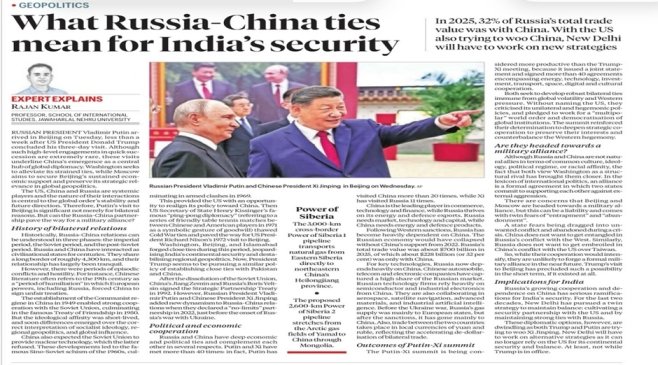
- Meetings Putin and Xi have met more than 40 times. Putin has visited China 20+ times; Xi has visited Russia 11 times.
- Complementarity China leads in commerce, technology, and finance; Russia thrives on energy and defence exports — creating a near-perfect economic complement.
- Putin–Xi 2025 summit Issued joint statement; signed 40+ agreements covering energy, technology, investment, transport, space, digital, and cultural cooperation.
- De-dollarisation Trade between the two countries takes place in local currencies — yuan and ruble — accelerating the de-dollarisation of bilateral trade.
- Multipolar world Both criticised US's unilateral and hegemonic policies; pledged to work for a multipolar world order and democratisation of global institutions.
| KEY words and points |
Ø 32%
Ø Share of Russia's total trade in 2025 that was with China — up from near zero in 2021
Ø $700B
Ø Russia's total trade value in 2025; ~$228 billion (32%) was with China alone
Ø 4,300
Ø Kilometres of shared Russia–China border — one of the world's longest land borders
Ø 40+
Ø Agreements signed at the 2025 Putin–Xi summit in Beijing
IMPLICATIONS FOR INDIA
- Twin strategy For two decades, India pursued a twin balance: cultivating a security partnership with the US and maintaining strong ties with Russia. This is now under stress.
- Options dwindling Both Trump (wooing China) and Putin (embracing China) are squeezing India's strategic space. New Delhi can no longer rely on the US for its continental security and balance.
- China centrality As China becomes more central to both US and Russian diplomacy, India's ability to play both sides diminishes — strategic autonomy is being tested.
- New strategies needed India must work on alternative strategies — deepening ties with Europe, West Asia, Global South; accelerating domestic defence manufacturing; reducing import dependency on Russia.
- Russia dependency risk India remains heavily dependent on Russia for defence imports (aircraft, missiles, submarines). A Russia deeply aligned with China — India's primary adversary — poses serious security ramifications.