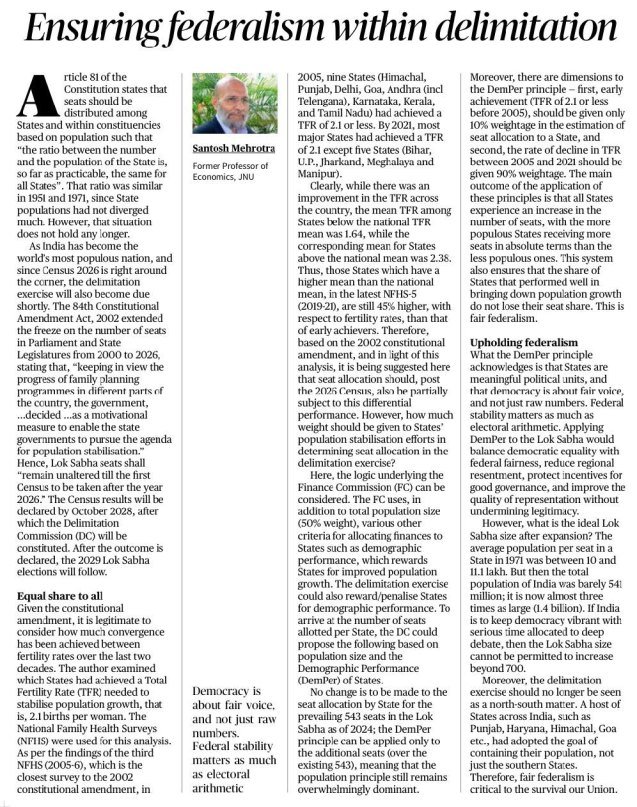
Background:-
- Article 81 of the Constitution provides that Lok Sabha seats should be allocated among States based on population, ensuring equal representation as far as practicable.
- However, the number of Lok Sabha seats has remained frozen since the 1971 Census.
- The freeze was extended through the 84th Constitutional Amendment Act, 2002 till the first Census after 2026.
- The purpose was to ensure that States implementing effective population control measures were not politically disadvantaged.
Why Delimitation Matters Now
- Census 2026 is expected to trigger a fresh delimitation exercise before the 2029 Lok Sabha elections.
- India’s demographic patterns have changed significantly since 1971, with States showing varying rates of population growth and fertility decline.
Core Concern
- States that successfully controlled population growth fear losing their share of parliamentary seats.
- States with higher population growth may gain greater political representation.
- This has generated concerns regarding regional imbalance and federal fairness, especially between southern and northern States.
Demographic Performance (DemPer) Principle
- The article argues that seat allocation should not depend solely on population size.
- It proposes incorporating “Demographic Performance” into delimitation to reward States that stabilised population growth through effective governance and family planning policies.
Basis of the Proposal
- The Finance Commission already uses demographic performance as a criterion while distributing finances among States.
- A similar principle can be applied in delimitation.
Suggested Model
- The existing 543 Lok Sabha seats should continue to be allocated mainly on the basis of population.
- The DemPer principle should apply only to additional seats created after expansion of the Lok Sabha.
Proposed Weightage
- The article suggests:
•10% weight for States that achieved replacement-level fertility (TFR 2.1 or below) before 2005.
•90% weight for reduction in fertility rates between 2005 and 2021.
Why the Proposal is Considered Fair
- States that invested in education, healthcare, women’s empowerment, and family planning would not lose political influence.
- More populous States would still gain seats in absolute numbers.
- At the same time, States with better demographic performance would retain a fair share of representation.
Federal Significance
- The proposal recognises that democracy is not merely about numerical majorities but also about maintaining federal balance.
- It may reduce regional resentment and strengthen cooperative federalism.
- It acknowledges States as meaningful political units within the Union.
Need to Expand Lok Sabha
- India’s population has nearly tripled since 1971, while Lok Sabha seats remain capped at 543.
- The article argues that an expanded Lok Sabha may be necessary to ensure better representation and effective parliamentary functioning.
- However, it suggests that the Lok Sabha size should not increase excessively beyond manageable limits.
Key Takeaway
Delimitation after 2026 must balance:
- Equality of representation based on population, and
- Federal fairness for States that achieved demographic stabilisation.
⇒A balanced approach combining population and demographic performance can preserve national unity, reduce inter-State tensions, and strengthen Indian federalism.