Introduction
- India and the United Arab Emirates (UAE) have significantly deepened their bilateral partnership in recent years. What began primarily as an energy relationship has now expanded into a comprehensive strategic partnership covering defence, infrastructure, trade, maritime security, investment, technology, and regional stability.
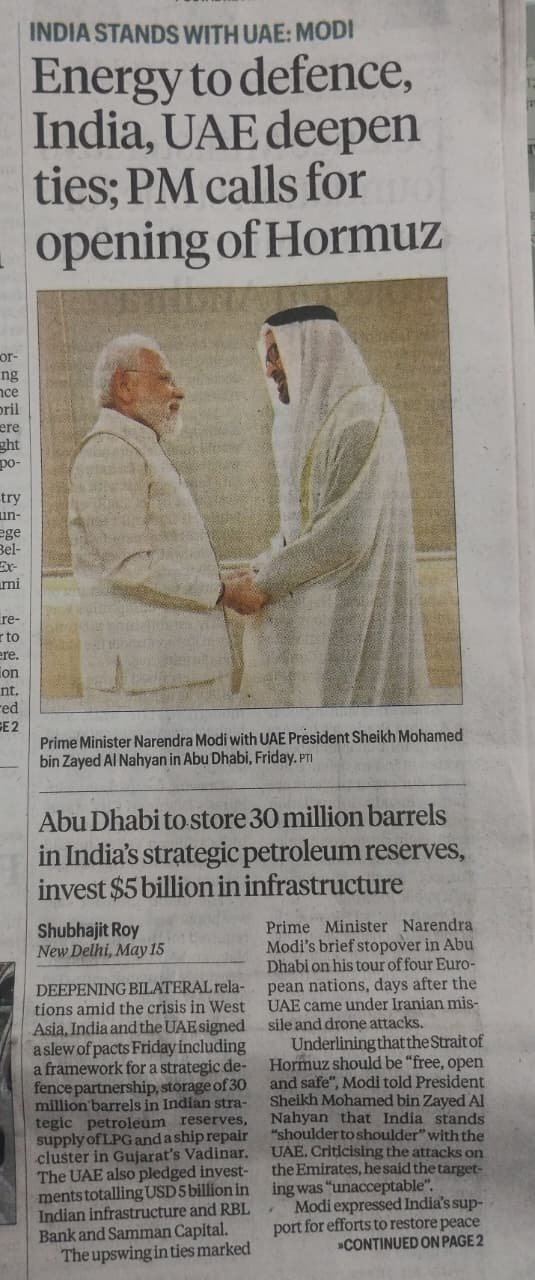
- Prime Minister Narendra Modi’s recent visit to Abu Dhabi marked another important milestone in India-UAE relations, especially amid growing instability in West Asia and tensions around the Strait of Hormuz.
Why is the India-UAE Partnership Important?
- The UAE is one of India’s most important strategic partners in the Gulf region because:
- It is India’s major energy supplier
- Hosts nearly 3.5 million Indians
- Acts as a gateway to West Asia and Africa
- Supports India’s food and energy security
- Is a key investor in Indian infrastructure and logistics
Major Outcomes of PM Modi’s UAE Visit
1. Strategic Defence Partnership
- India and UAE signed a Framework for Strategic Defence Partnership.
- Key Areas of Cooperation:
- Defence industrial collaboration
- Joint military exercises
- Maritime security
- Cybersecurity cooperation
- Intelligence and information sharing
- Advanced defence technologies
2. Strategic Petroleum Reserve Agreement
- One of the most significant developments was the agreement between:
- Indian Strategic Petroleum Reserves Limited (ISPRL) and
- Abu Dhabi National Oil Company (ADNOC)
Main Features:
- UAE will store 30 million barrels of crude oil in India’s strategic petroleum reserves.
- Both countries will also explore creating additional reserves in India.
Why Important?
- This strengthens India’s:
- Energy security
- Emergency oil reserves
- Supply chain resilience during global crises
What is India’s Strategic Petroleum Reserve (SPR)?
- India maintains underground crude oil storage facilities to ensure energy security during supply disruptions.
Current Major SPR Facilities:
- Visakhapatnam (Andhra Pradesh)
- Mangaluru (Karnataka)
- Padur (Karnataka)
Total Existing Capacity:
- India currently maintains approximately:
→5.33 Million Metric Tonnes (MMT) of crude oil reserves.
3. UAE’s Importance in India’s Energy Security
UAE’s Role:
- UAE is India’s 4th largest crude oil supplier
- Supplies around 11% of India’s crude oil requirement
- UAE is also India’s largest LPG supplier
- It fulfills nearly 40% of India’s LPG imports
⇒This makes UAE central to India’s household energy and industrial needs.
4. Investment Commitments Worth USD 5 Billion
- The UAE announced investments totaling: USD 5 Billion
Key Investment Channels:
(a) Abu Dhabi Investment Authority (ADIA)
- Investment up to USD 1 billion in Indian infrastructure
(b) Emirates NBD
- Investment worth USD 3 billion in India’s banking sector
(c) International Holding Company
- Investment worth USD 1 billion in Sammaan Capital India
5. Focus on the Strait of Hormuz
PM Modi stressed that the: “Strait of Hormuz must remain free, open and safe.”
Why is Strait of Hormuz Important?
⇒The Strait of Hormuz is one of the world’s most critical oil transit chokepoints.
Important Facts:
- Nearly 20% of global oil trade passes through it.
- Connects the Persian Gulf with the Arabian Sea.
- Essential for India’s energy imports.
⇒Any disruption can severely affect global oil prices and supply chains.
India’s Position on West Asia
India adopted a balanced and diplomatic approach by:
- Supporting peace efforts
- Condemning attacks on UAE
- Advocating stability in West Asia
- Supporting uninterrupted maritime navigation
Growing Defence Cooperation
India and UAE are increasingly cooperating in:
- Naval security
- Counter-terrorism
- Intelligence sharing
- Drone and cyber defence
- Defence manufacturing
Recent Trends:
- Joint military exercises
- Naval visits
- Counter-radicalisation cooperation
Economic Relations Between India and UAE
Bilateral Trade
- India-UAE trade has grown rapidly after the signing of:
CEPA (Comprehensive Economic Partnership Agreement)
Signed in: 2022
Impact:
- Reduced tariffs
- Increased exports
- Faster customs clearance
- Boost to MSMEs and startups
Indian Diaspora in UAE
- The Indian community in UAE is one of the largest expatriate populations.
Contributions:
- Remittances
- Skilled workforce
- Business investments
- Cultural connectivity
⇒PM Modi thanked UAE leadership for taking care of Indians residing there.
Strategic Significance for India
The India-UAE partnership helps India:
- Secure energy supplies
- Expand influence in West Asia
- Counter regional instability
- Diversify strategic partnerships
- Strengthen maritime security
Key Challenges
- Despite strong ties, challenges remain:
- Regional instability in West Asia
- Iran-Israel tensions
- Global oil price volatility
- Geopolitical competition in the Gulf
Important Facts for Exams
Topic| Fact
- UAE’s crude oil contribution| ~11% of India’s requirement
- UAE’s LPG contribution| ~40% of India’s imports
- UAE investment commitment| USD 5 billion
- Oil storage agreement| 30 million barrels
- Existing Indian SPR capacity| 5.33 MMT
- Major agreement| CEPA (2022)
Relevance for UPSC / RAS
- Important Topics:
- India-UAE Relations
- West Asia Geopolitics
- Energy Security
- Strategic Petroleum Reserves
- Strait of Hormuz
- Maritime Security
- CEPA Agreement
Conclusion
- India-UAE relations have evolved far beyond traditional energy ties into a multidimensional strategic partnership. In an era of geopolitical uncertainty and global energy insecurity, the growing cooperation between both nations reflects shared economic interests, regional stability concerns, and long-term strategic trust.
- The strengthening of ties in defence, energy, infrastructure, and maritime security indicates that the India-UAE partnership will remain one of the most significant pillars of India’s West Asia policy in the coming decades.