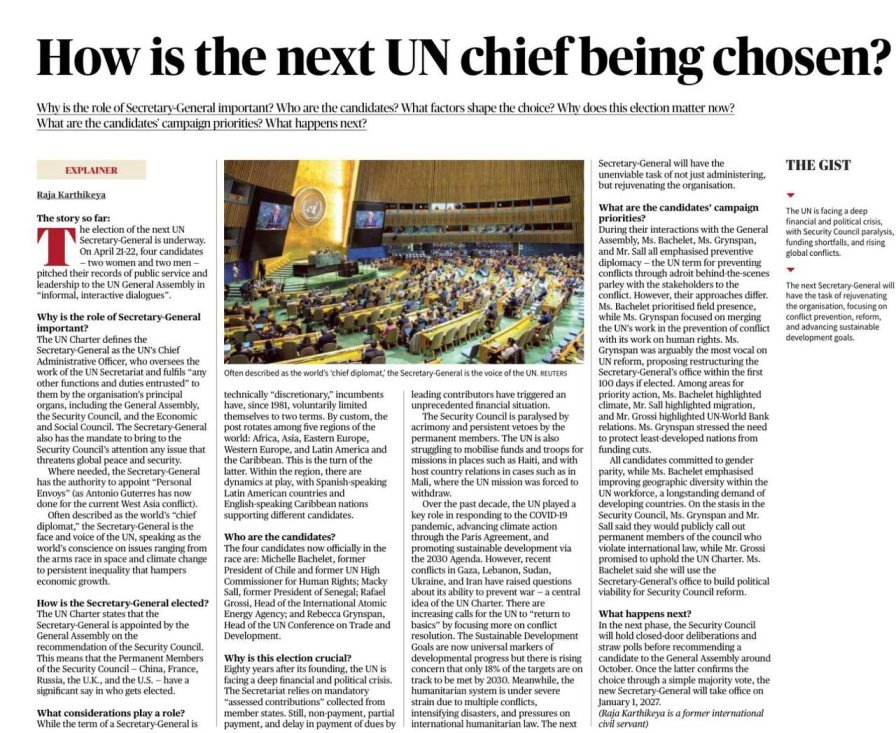
Introduction:-
- The selection of the United Nations Secretary-General (UNSG) is a two-step political and diplomatic process involving both the United Nations Security Council (UNSC) and the United Nations General Assembly (UNGA). The choice reflects global power dynamics, regional balance, and evolving leadership priorities.
Role and Importance of the UNSG:-
- The UNSG serves as the Chief Administrative Officer of the United Nations. The office-holder acts as the world’s leading diplomat, mediating conflicts, promoting peace, and fostering international cooperation. The UNSG also has the authority to bring matters threatening international peace and security before the UNSC, making the position both administrative and politically influential. Additionally, the role symbolizes the moral voice and leadership of the UN system.
Election Process:-
The selection process occurs in two stages:-
- First, the UNSC recommends a candidate. This involves informal consultations and secret “straw polls” to gauge support. The five permanent members—United States, United Kingdom, France, Russia, and China—hold veto power, which is decisive in blocking any candidate.
- Second, the UNGA appoints the recommended candidate by a simple majority vote. The term of office is five years, typically renewable once.
Key Factors Influencing the Choice:-
Several informal and formal considerations shape the selection:
- The principle of regional rotation, though not codified, guides equitable representation.
- Geopolitical consensus among the permanent members of the UNSC is crucial.
- The candidate’s diplomatic experience, neutrality, and leadership skills are essential.
- Increasing emphasis is placed on gender balance and diversity.
Current Context and Significance:-
- The UN today faces multiple challenges, including financial constraints and funding gaps, rising geopolitical conflicts (such as in West Asia and Ukraine), and a broader crisis of multilateralism. There is growing pressure to reform the UN system, particularly the Security Council, to enhance its legitimacy and effectiveness. In this context, the choice of UNSG assumes heightened importance.
Emerging Priorities for Candidates:-
- Candidates are generally expected to focus on preventive diplomacy and conflict resolution, climate change, migration, and the achievement of Sustainable Development Goals (SDGs). Strengthening representation of the Global South and improving institutional efficiency and funding mechanisms are also key concerns.
What Happens Next?
Following closed-door consultations, the UNSC finalizes its recommendation. The UNGA then formally appoints the candidate, who assumes office at the beginning of the next term cycle.India’s Perspective:-
India advocates comprehensive UN reforms, particularly the expansion of the UNSC. It emphasizes greater representation for the Global South and supports a stronger UN role in peacekeeping and development initiatives.
Conclusion:-
- The selection of the UNSG is not merely procedural but deeply political, reflecting prevailing global power equations and shaping the future direction of the United Nations.