
-
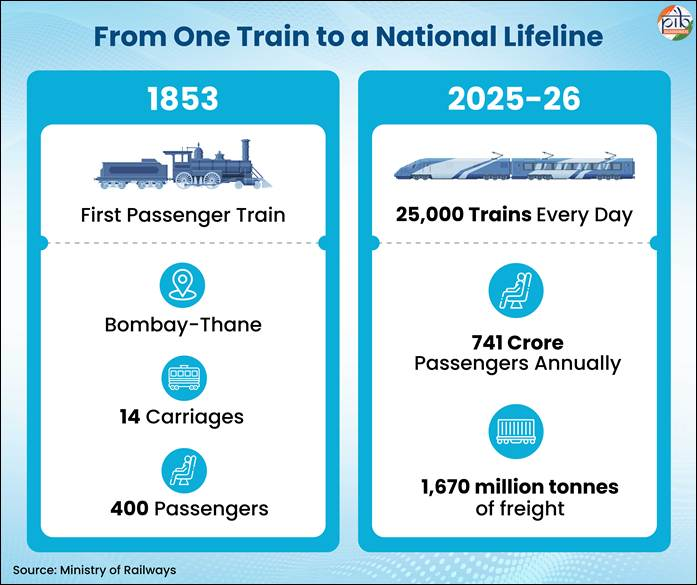
News: Railways in India began with the first passenger train (a Steam engine) running between Bombay and Thane on 16th April, 1853.
-
Historical Background
-
Approximately 400 passengers boarded the train for the inaugural run.
-
The train consisted of 14 passenger carriages operated by the Great Indian Peninsula Railway (GIPR) and was pulled by a steam locomotive named "Falkland".
-
The departure was accompanied by a ceremonial 21-gun salute, symbolising the beginning of railway transport in India.
-
The train successfully completed its journey of about 34–35 kilometres, demonstrating the practical potential of railways for passenger movement.
-
In 1895, the first steam locomotive built in India was produced at the Ajmer Workshop of the Rajputana Malwa Railway.
-
This represented an important step towards domestic railway engineering and maintenance capability.
-
-
In India, the transition towards electric traction began in 1925, when the country’s first electric train operated between Bombay Victoria Terminus and Kurla Harbour.
-
-
Gauge
-
The clear minimum distance between the running faces of the two rails is called Gauge.
-
Depending upon the gauge, Indian Railways has the following categories of track:
-
Broad Gauge – 1.6 metre
-
Metre Gauge – 1 metre
-
Narrow Gauge– 0.76 metre and 0.6 metre
-
Standard Gauge – 1.43 metre
-
-
-
Railway Electrification
-
As of March 2026, the transformation is nearly complete, with 99.6% railway network electrified out of the total 70,142 broad gauge route kilometers.
-
Advantage
-
Reducing the need for crude oil imports: Railway electrification saved approximately 180 crore litres of diesel in 2024–25,
-
Electric traction is environmentally friendly and about 70% more economical than diesel traction.
-
Electrification has resulted in savings of approximately ₹6,000 crore, with diesel consumption steadily declining.
-
-
-
The Vande Bharat Network
-
-
Launched: February 2019
-
It is India’s first indigenously designed and manufactured semi-high-speed train.
-
The service represents a major step towards modern, comfortable, and technology-driven rail travel under the Make in India initiative.
-
The Vande Bharat Sleeper service,
-
launched: January 2026.
-
-
-
-
Amrit Bharat Express
-
To provide affordable transportation for low- and middle-income families, Indian Railways has introduced the Amrit Bharat Express.
-
They are a new generation of fully non-AC modern trains designed to improve comfort and safety while maintaining economical travel options.
-
As of 18th March 2026, a total of 60 Amrit Bharat Express services are being operated across the Indian Railways network.
-
-
Development of High-Speed Rail in India
- The Union Budget 2026–27 allocated a record capital outlay of ₹2,78,000 crore for Indian Railways.
-
As part of this vision, the development of seven high-speed rail corridors has been announced as growth connectors.
-
- The Union Budget 2026–27 allocated a record capital outlay of ₹2,78,000 crore for Indian Railways.
-
-
The Mumbai–Ahmedabad High-Speed Rail (MAHSR) Corridor
-
Maximum speed: 320 kilometres per hour.
- Total length: ~508 kilometres.
-
It represents India’s first concrete step towards introducing high-speed rail systems in the country.
-
-
-
Key Facts:
-
4th Largest network in the world.
-
26% of the freight traffic in the country is contributed by the Indian Railways.
-
-
Govt Scheme related to Indian Railway
-
Amrit Bharat Station Scheme (2022)
-
National Rail Plan (NRP) for India 2030.
-
Government has allowed 100% FDI in the railway sector.
-
Kavach System: Kavach commissioned over 3,100 route kilometres, with implementation underway on an additional 24,400 kilometres.
-
-
Committees related to Railways
-
Kakodkar Committee (2012)
-
Bibek Debroy Committee (2014)
-
Vinod Rai Committee (2015)
-
Source: PIB