1. Macro Trends (2025-26)
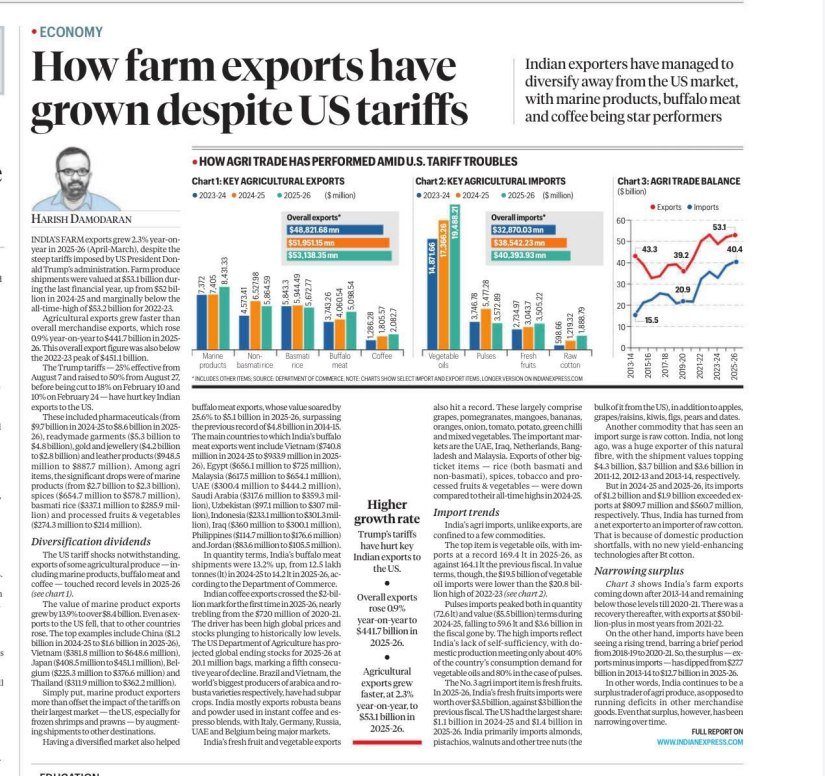
- Agri Exports: Grew 2.3% YoY to reach $53.1 Billion. (Just below the all-time high of $53.2 Bn in 2022-23).
- Agri exports grew faster than India's overall merchandise exports (which only rose 0.9%).
2. Impact of US Tariffs & Diversification Strategy
- The Shock: Steep US tariffs hit Indian exports hard, including agri items like marine products, spices, and basmati rice.
- The Pivot (Diversification Dividend): Exporters successfully absorbed the shock by diversifying away from the US market and finding new buyers globally.
3. Star Export Performers (Offsetting the US deficit)
- Marine Products: Export value crossed $8.4 Bn (up 13.9%). Losses in the US market (especially for frozen shrimps/prawns) were offset by aggressively exporting to China, Vietnam, Japan, and Belgium.
- Buffalo Meat: Hit a record $5.1 Bn (up 25.6%).
Top buyers: Vietnam, Egypt, Malaysia. - Coffee: Crossed the $1 Billion mark for the first time. Driven by high global prices and 5 years of declining global stocks. Note: India mostly exports Robusta beans (Main markets: Italy, Germany, Russia).
- Fresh Fruits/Veg: Hit record highs (Top markets: UAE, Iraq, Netherlands).
Lagging: Rice (basmati/non-basmati) and spices dropped compared to their 2024-25 highs.
4. Import Vulnerabilities (Concentrated Basket)
- Vegetable Oils (#1 Import): Hit a record import volume of 169.4 lakh tonnes. Structural issue: Domestic production only meets ~40% of India's demand.
- Pulses (#2 Import): Imports remain high as domestic production only meets ~80% of demand.
- Raw Cotton (Major Shift): India has turned from a huge net exporter of raw cotton into an importer. Reason:Domestic shortfalls and lack of new yield-enhancing technologies since Bt cotton.
- Fresh Fruits (#3 Import): Valued at $3.5 Bn (primarily apples and dry fruits like almonds/walnuts from the US).
5. Trade Balance Conclusion
- Unlike overall merchandise trade, India continues to hold a Trade Surplus in agriculture.
- The Catch: This surplus is narrowing over time. It has dipped from $27.7 Bn (2013-14) down to $12.7 Bn (2025-26) because agri imports are surging fast.