
News:-
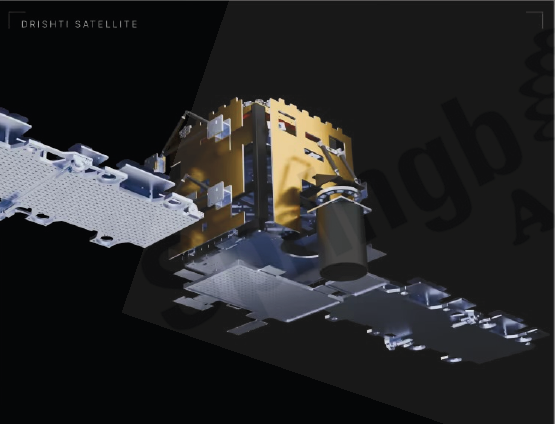
- Mission Drishti, the world's first OptoSAR satellite, developed by Bengalurubased space startup GalaxEye, was successfully launched by SpaceX on a Falcon 9 rocket from Vandenberg, California, on May 3, 2026.
Key Points:-
- The largest Earth observation satellite (weighing approximately 190 kg) developed by an Indian private company.
- The world's first OptoSAR satellite.
◦ Integrates two imaging technologies—optical imaging and synthetic aperture radar (SAR)—in a single platform.
◦ Optical sensors capture visible-spectrum images, while SAR uses microwave signals to capture images. - Capable of observing the Earth day and night in all weather conditions.
- Placed in sun-synchronous low Earth orbit (LEO).
- Highest resolution among satellites launched by Indian private companies.
- Applications – Designed for use in defense, disaster management, agriculture,
and urban planning.
The Role of the Private Sector in the Indian Space Sector:-
- By 2026, the private sector in the Indian space sector have moved from a vendor role to an independent end-to-end service provider.
- India's space economy has reached approximately $8.4 billion, with 399 startups working in areas such as launch vehicles, satellites, propulsion systems, and space-grade electronics.
Key private sector achievements in the Indian space sector:-
- As of January 31, 2026, 71 technology transfers from ISRO have been facilitated to industry (including startups) through IN-SPACe.
- Skyroot Aerospace to launch India's first private suborbital rocket, Vikram-S, in 2022.
◦ Development of India's first private orbital rocket, Vikram-1. - Successful launch of the world's first rocket with a fully 3D-printed engine, Agniban Sorted, in May 2024 by Agnikul Cosmos, a space startup incubated at IIT Madras.
- Development of Firefly, a hyperspectral satellite constellation, by Bengaluru-based startup Pixxel.
◦ Contract to provide hyperspectral imaging with the US National Reconnaissance Office (NRO). - Development of Drishti, the world's first OptoSAR satellite mission, by Bengaluru-based space startup GalaxEye.
Key initiatives taken by the government to enable the role of the private sector in the Indian space sector:-
- In June 2020, the Union Cabinet, chaired by the Prime Minister, decided toopen up the space sector and enable Indian private sector participationacross the entire spectrum of space activities.
- Establishment of the Indian National Space Promotion and AuthorizationCentre (IN-SPACe) to facilitate private sector participation.
◦ An autonomous agency under the Department of Space (DOS).
◦ Responsible for promoting, enabling, authorizing, and monitoring various space activities of non-governmental space organizations (NGEs). - The Indian Space Policy 2023 formally opened the sector to non-governmental entities.
- A liberalized foreign direct investment policy regulating the space sector was announced.
- A venture capital fund of ₹1,000 crore was established.
- A Technology Adoption Fund (TAF) of ₹500 crore was established for the development and commercialization of space technology.
- The IN-SPACe pre-incubation entrepreneurship program to identify and train entrepreneurs in the space sector.
- Schemes such as Satellite Bus as a Service and Ground Station as a Service have been announced.
Expected MCQ
Q. Consider the following statements in the context of the recently launched Mission Drishti:
1. It is the world's first OptoSAR satellite, integrating optical and SAR imaging technologies.
2. It was developed by Bengaluru-based space startup GalaxEye.
3. It has been placed in Sun-synchronous Low Earth Orbit (LEO).
4. Synthetic Aperture Radar (SAR) technology uses the visible spectrum, while optical sensors use microwave signals.
Select the correct answer using the code given below:
(a) 1 and 3 only
(b) 1, 2, and 3 only
(c) 2 and 4 only
(d) 1, 2, 3, and 4
Practice Question for Mains:-
Q. Briefly describe the major achievements of the private sector in the Indian space sector.