
Open-Field Observatory of Coastal Atmospheric Research Testbed (C-ART):-
News:-
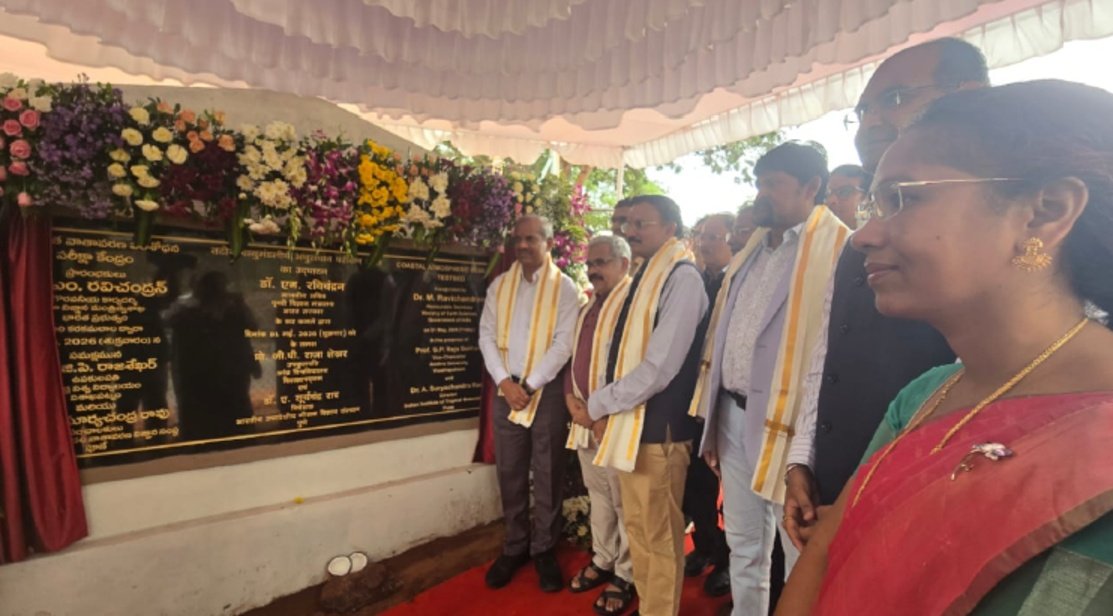
- On May 1, 2026, Dr. M. Ravichandran, Secretary, Ministry of Earth Sciences, inaugurated the Open-Field Observatory of Coastal Atmospheric Research Testbed (C-ART) at Andhra University (AU), Visakhapatnam.
Key Points:-
- Established by the Indian Institute of Tropical Meteorology (IITM), Pune, an autonomous institute under the Ministry of Earth Sciences, Government of India
- A significant achievement under the Ministry of Earth Sciences' (MoES) 'Mission Mausam' initiative.
- Helpful in improving early warning systems for cyclones and extreme weather and aiding disaster management.
- Function as a national user facility to provide research observations to aid process-level diagnosis of monsoon convection, improve parameterization schemes in numerical weather prediction models, enhance forecast accuracy, and enable data assimilation experiments for model evaluation.
- Objective: Enhance observational networks and model forecasts.
Urban Testbed and Aerosol Observatory:-
News:-
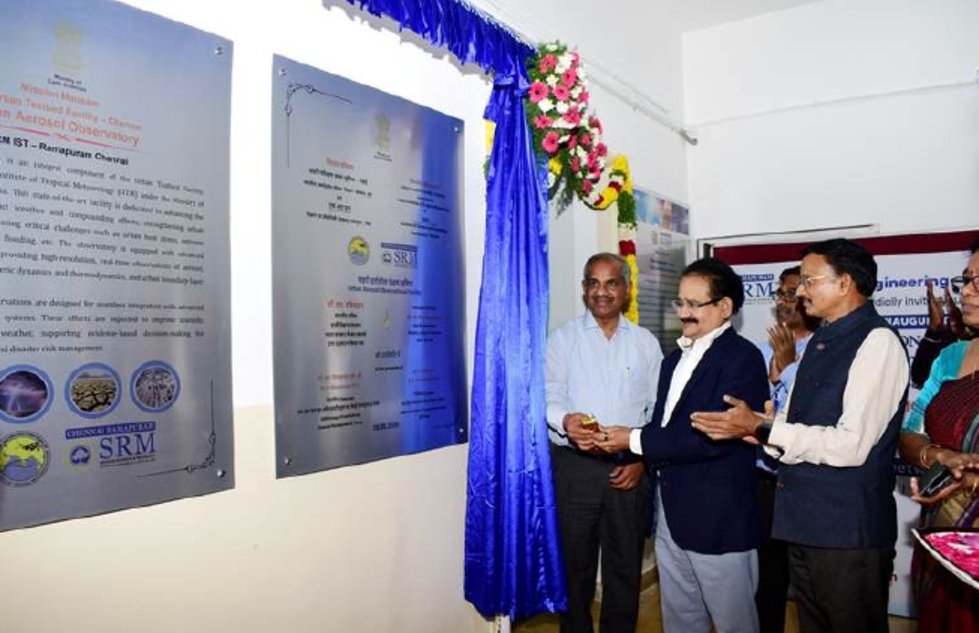
- Dr. M. Ravichandran, Secretary, Ministry of Earth Sciences, inaugurated the state-of-the-art Urban Testbed and Aerosol Observatory at the SRM Institute of Science and Technology (SRMIST) in Ramapuram, Chennai on May 6, 2026.
Key Points:-
- Established by the Indian Institute of Tropical Meteorology (IITM), Pune, an autonomous institute under the Ministry of Earth Sciences, Government of India.
◦ Operating under the 'Mission Mausam' initiative. - The first observatory of its kind to be established in India.
- The center homes approximately 15 state-of-the-art instruments designed to track approximately 50 types of atmospheric data, including weather patterns, wind flow, aerosol particles, and temperature changes.
- By analyzing factors such as the size and speed of airborne particles, variations between sea and land winds, and the biological or inorganic nature of aerosols, scientists can better predict their specific impacts on weather.
- This facility will provide critical short-term data regarding global warming in the region, which will subsequently aid research on long-term climate impacts.
Mission Mausam:-
- Approved by the Government of India on September 11, 2024, under theMinistry of Earth Sciences.
- Initial outlay – ₹2,000 crore (for 2 years).
◦ Implemented in phases until 2031. - Aim – To make the country 'weather-ready' and 'climate-smart', meeting global standards.
- Nodal Agency – Three institutes under the Ministry of Earth Sciences:
◦ India Meteorological Department (IMD)
◦ National Centre for Medium-Range Weather Forecasting (NCMRWF)
◦ Indian Institute of Tropical Meteorology (IITM)
Objectives:-
◦ To enhance India's weather forecasting capabilities at various scales –short-range, medium-range, extended-range, and seasonal.
◦ To develop high-resolution models for improved and more accurate predictions of changes in monsoon patterns.
◦ To strengthen the network of weather observations using advanced radars, satellites, and automated weather stations.
◦ To provide implementable advisories for sectors related to agriculture, water resources, energy, health, and disaster management.
◦ To build capacity through research collaborations with national and international institutions
Indigenous Cell Broadcast System (CBS):-
News:-
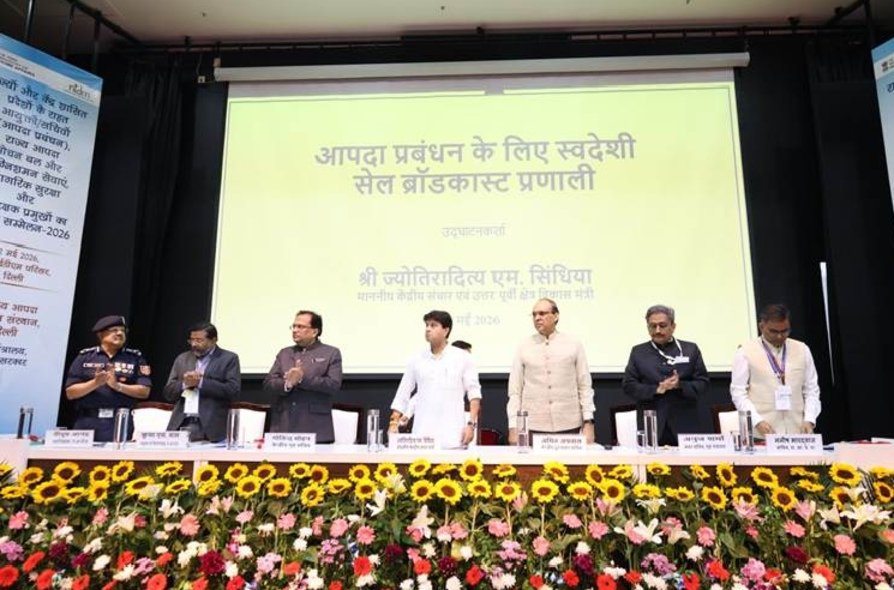
- Union Communications Minister Jyotiraditya Scindia launched the indigenously developed Cell Broadcast System (CBS) on May 2nd.
Key Points:-
- Developed by the Centre for Development of Telematics (C-DOT) under the Department of Telecommunications (DoT) in collaboration with the National Disaster Management Authority (NDMA) and the Ministry of Home Affairs.
- A telecom-based public warning system that allows authorities to send precise, geo-targeted alerts simultaneously to all mobile devices within a certain area.
- Alerts are sent in near-real time and in multiple languages.
- Unaffected by network congestion.
- Alerts come as priority notifications with a pop-up message and a loud sound, and many phones also have the ability to audibly read these messages.
- Users cannot turn off these alerts.
- Works on all networks from 2G to 5G.
- Integrated with the "SACHET" platform.
- As part of the launch, the system was successfully tested across the country.
- C-DOT successfully demonstrated this technology in countries like Mauritius,
Cambodia, El Salvador, and Sri Lanka in line with the United Nations' Early
Warning for All initiative.
SACHET Platform:-
* An integrated alerting system developed by the NDMA and C-DOT.
* Disseminates real-time, geographically targeted, and multilingual disaster warnings via SMS, app, and mobile broadcast.
* Operates in all 36 states and union territories of India.
Expected MCQs:-
Q. What is the primary objective of the open-field observatory of Coastal Atmospheric Research Testbed (C-ART), recently inaugurated at Andhra University (AU) in Visakhapatnam?
(a) Conservation of marine biodiversity
(b) Improve the accuracy of monsoon, cyclone, and weather forecasts
(c) Study of space weather
(d) Promotion of coastal tourism
Q. Consider the following statements regarding the Urban Testbed and Aerosol
Observatory:
1. It was established by the Indian Institute of Tropical Meteorology (IITM).
2. This observatory is designed to track approximately 50 types of atmospheric data, including weather patterns, wind flow, aerosol particles, and temperature changes.
3. It is the first observatory in India established for urban atmospheric and aerosol studies.
4. Its primary purpose is to study seismic activity.
Select the correct answer using the code given below:
(a) 1, 2, and 3 only
(b) 1 and 4 only
(c) 2 and 3 only
(d) 1, 2, 3, and 4
Watch Full Video:-
Open-Field Observatory of Coastal Atmospheric Research Testbed (C-ART) Click Here 👈