
-
News: The Promotion and Regulation of Online Gaming Rules, 2026 will come into force on 1 May 2026.
-
The focus is on user safety and industry growth.
-
-
Legal Basis: The Rules flow from the Promotion and Regulation of Online Gaming (PROG) Act, 2025.
-
The Act addresses the rising harm of online money gaming.
-
It also enables growth of e-sports and online social games.
-
The aim is to foster innovation and creativity while protecting users from financial and social risks.
-
|
Online Gaming Sector
|
Promotion and Regulation of Online Gaming (PROG) Act, 2025Major Features
|
Promotion and Regulation of Online Gaming Rules, 2026
The Rules are built around six key pillars.
-
Online Gaming Authority of India
-
Attached office of the Ministry of Electronics and Information Technology
-
Head Office: National Capital Territory of Delhi.
-
Chaired by: Additional Secretary, MeitY.
-
Maintains and publishes the list of online money games and inquiries into complaints.
-
-
Determination of an Online Game
-
Rules provide for clear test to classify
-
Triggered through Suo motu action by the Authority, application by a service provider, or notification by the Central Government.
-
-
It is based on objective factors such as payment of stakes, expectation of monetary winnings, revenue model, and monetisation of in game assets outside the game.
-
To be completed, as far as practicable, within 90 days, with the outcome recorded in a determination order specific to the game and provider.
-
-
Registration of Online Games
-
Required only when notified by the Central Government. It applies to all games offered as e-sports. The decision is based on risk to users, scale, financial transactions and country of origin.
-
Validity of registration: Up to 10 years
-
Online money games are not eligible for recognition or registration as e-sports under the National Sports Governance Act, 2025.
-
-
User Safety Features
-
Includes age verification, age gating, time restrictions and parental controls.
-
-
Two-Tier Grievance Redressal and Appellate Mechanism
-
1st Appeal to Authority within 30 days if dissatisfied with provider’s resolution. Dispose appeal within 30 days
-
2nd Appeal to Appellate Authority ie, Secretary, MeitY. Dispose appeal within 30 days.
-
Every online game service provider must establish and maintain a functional grievance redressal system.
-
-
Penalties and Enforcement
-
Cases are to be concluded within 90 days from receipt of a complaint and in digital mode unless physical presence is considered necessary.
-
All penalties imposed under the Act shall be credited to the Consolidated Fund of India.
-
Positive impacts of these rules are:
-
Boost to creative economy
-
Empowering youth
-
Safe digital environment
-
Strengthening global leadership.
-
In combination, the Act and the Rules balance innovation with strong safeguards, ensuring sustainable growth of the sector.
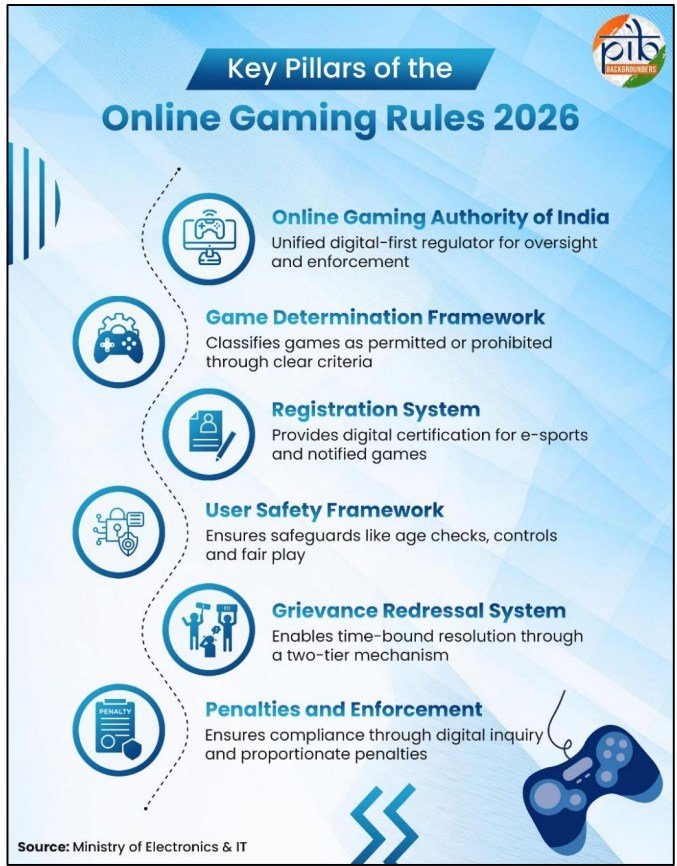
Source: PIB