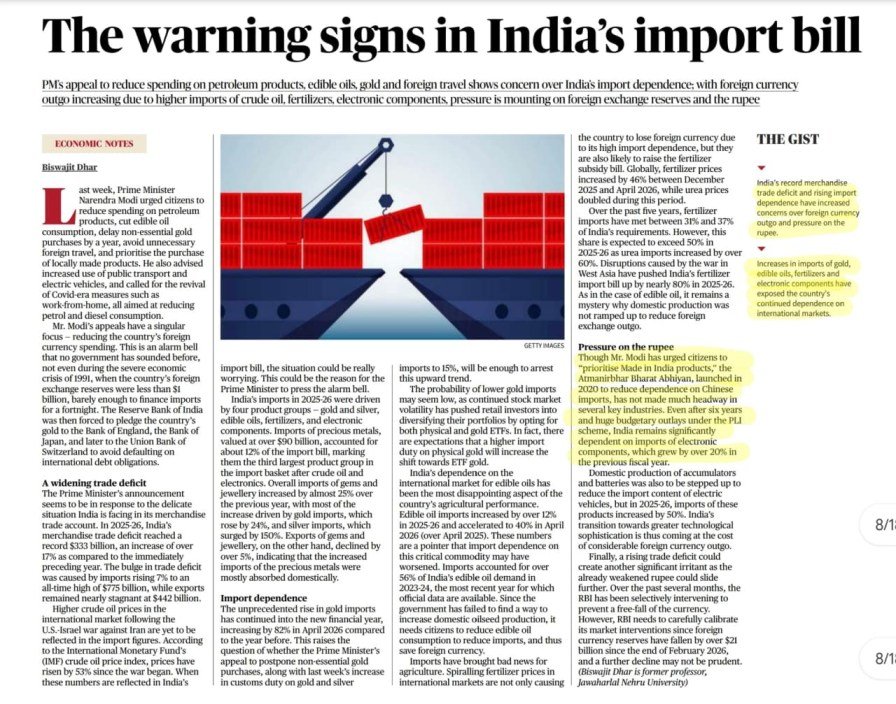
Why in Focus?
- Prime Minister Narendra Modi recently urged citizens to reduce expenditure on:
- Petroleum products
- Edible oils
- Gold
- Foreign travel
⇒ The appeal reflects growing concerns regarding India’s rising import dependence and mounting pressure on foreign exchange reserves and the rupee.
India’s Rising Trade Deficit
- India’s merchandise trade deficit in FY 2025–26 reportedly reached nearly $333 billion, registering a rise of over 17% compared to the previous year.
- Imports increased to around $775 billion
- Export growth remained comparatively sluggish
⇒ This widening gap has intensified concerns over external sector stability.
Major Drivers of Import Surge
- Four major categories contributed significantly to the increase in imports:
- Gold and silver
- Edible oils
- Fertilizers
- Electronic components
⇒ Together, these accounted for more than 12% of India’s total import bill.
Gold Imports: A Growing Concern
- Gold imports increased sharply due to:
- Preference for safe-haven assets during uncertainty
- Volatility in equity markets
- Rising demand for Gold ETFs and physical gold
⇒ Silver imports also witnessed a substantial rise, increasing pressure on the current account balance.
Dependence on Edible Oil Imports
- India continues to rely heavily on imported edible oils.
- Imports account for over 56% of domestic edible oil demand
- Weak oilseed productivity and inadequate domestic production have increased foreign exchange outflows
⇒ This dependence exposes India to global price fluctuations and supply disruptions.
Fertilizer Import Pressure
Global fertilizer prices surged amid tensions in West Asia.
- Urea prices reportedly doubled between December 2025 and April 2026
- India’s fertilizer import bill rose sharply due to:
- Dependence on imported fertilizers
- Rising international prices
- Geopolitical disruptions
⇒ This has increased subsidy burdens and external vulnerabilities.
Electronics Import Dependence
Despite initiatives such as:
- Make in India
- Atmanirbhar Bharat Abhiyan
- Production Linked Incentive (PLI) Scheme
India remains dependent on imported electronic components.
- Imports of electronic components grew by over 20% in the previous fiscal year
- Imports of EV batteries and accumulators also increased significantly
Limited domestic value addition remains a major structural challenge.
Pressure on the Rupee
- Rising import dependence is widening the current account deficit and exerting downward pressure on the rupee.
- The Reserve Bank of India (RBI) has intervened selectively in forex markets to curb excessive depreciation
- However, prolonged intervention may reduce foreign exchange reserves
Structural Concerns
- India’s import vulnerability is linked to:
- High energy dependence
- Weak manufacturing ecosystems
- Limited domestic value addition in electronics
- Low oilseed productivity
- Dependence on imported fertilizers
⇒These structural issues continue to affect long-term external stability.
Way Forward
- Strengthen domestic manufacturing through Make in India and PLI schemes
- Increase domestic production of oilseeds and fertilizers
- Develop semiconductor and electronics supply chains
- Promote public transport and EV adoption to reduce petroleum imports
- Enhance export competitiveness to sustainably reduce trade deficits
Conclusion
- Rising imports of gold, edible oils, fertilizers, and electronic components highlight India’s continuing dependence on global markets. Unless domestic production capacities and export competitiveness improve substantially, pressure on the rupee and external sector stability may persist in the coming years.