
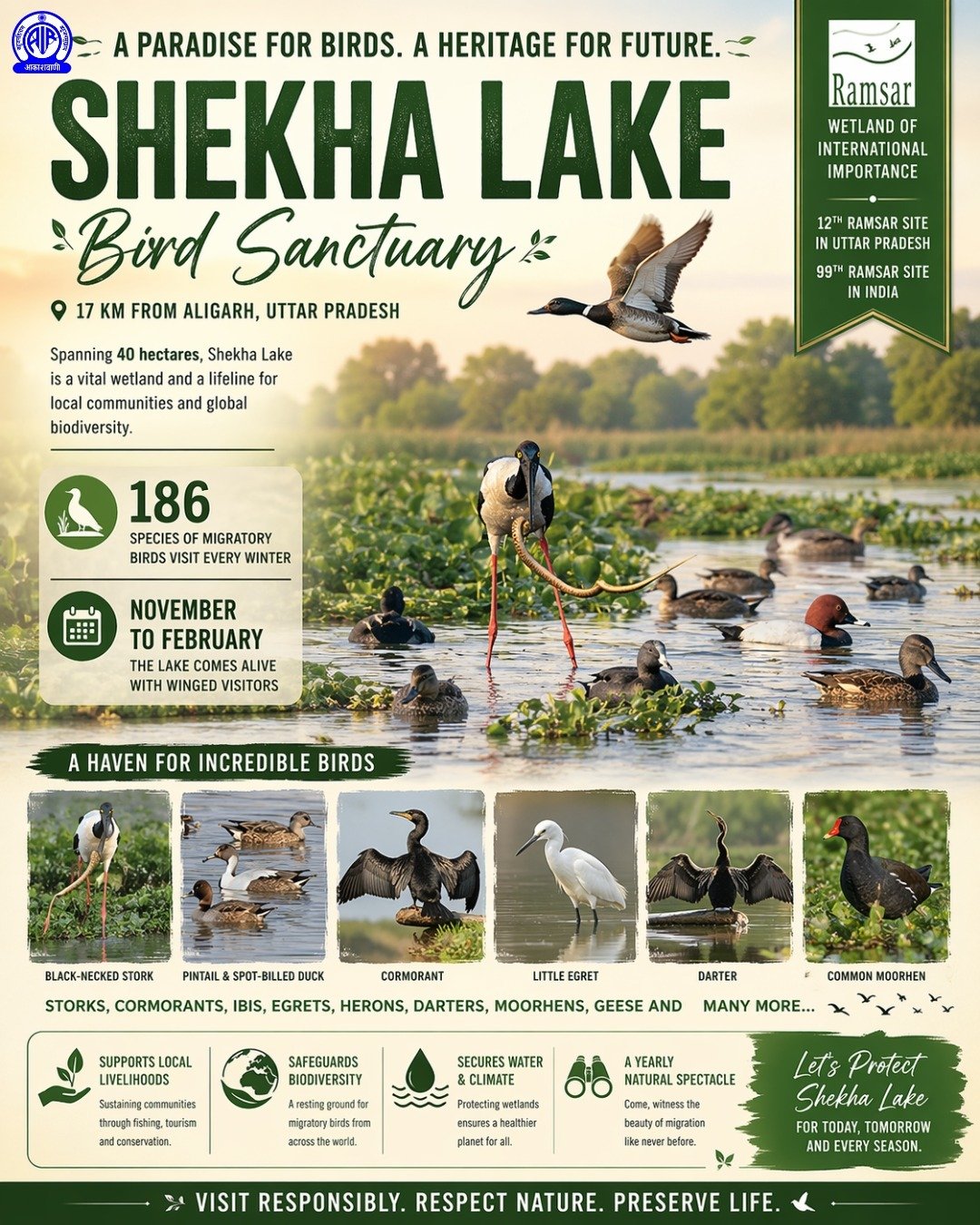
Shekha Lake Bird Sanctuary, Uttar Pradesh
- It has been declared India's 99th Ramsar Site.
- The 12th Ramsar Site of Uttar Pradesh.
- Spread across 40 hectares and situated approximately 17 kilometers from Aligarh in the state of Uttar Pradesh, Shekha Lake is a favorite destination for nearly 186 species of migratory birds during the winter season.
- Shekha Lake serves as a crucial stopover point along the Central Asian Flyway.
- It acts as a wintering ground for Bar-headed Geese, Painted Storks, and various species of ducks and waterbirds.
- The lake is vital for local livelihoods and global biodiversity, as well as for water and climate security.
Ramsar Site
- An intergovernmental treaty signed on February 2, 1971, in the city of Ramsar, Iran, for the conservation and sustainable use of wetlands.
- World Wetland Day: 2 February.
- Effective: 1975
- Parties: 173
- Objective: To conserve and ensure the wise use of all wetlands through actions taken at local and national levels, as well as through international cooperation.
- The Contracting Parties under the Convention are committed to the following:
- Ensuring the wise use of all their wetland areas.
- Designating appropriate wetlands for inclusion in the List of Wetlands of International Importance (the Ramsar List) and ensuring their effective management.
- Cooperating internationally regarding transboundary wetlands, shared wetland systems, and shared species.
|
What is a Ramsar Site?
|
What is a Wetland?
- According to the Ramsar Convention:
- Wetlands are areas of marsh, fen, peatland, or water- whether natural or artificial, permanent or temporary.
- These include areas with static or flowing water, comprising fresh, brackish, or saline water. including areas of marine water the depth of which at low tides does not exceed six meters.
- Wetlands serve as transitional zones between terrestrial and aquatic ecosystems.
- Montreux Record:
- It is a register of wetland sites included in the Ramsar List where changes in ecological character have occurred, are occurring, or are likely to occur as a result of technological developments, pollution, or other human interference.
- Two of India's wetlands are included in the Montreux Record:
- Keoladeo National Park (Bharatpur), Rajasthan
- Loktak Lake, Manipur
- India's Status in the Ramsar Convention:
- Joined the Ramsar Convention on February 1, 1982.
- Total Ramsar Sites: 99
- Largest Ramsar Site: Sundarbans Wetland, West Bengal.
- Smallest Ramsar Site: Vembannur Wetland Complex, Tamil Nadu.
- India's First Ramsar Sites: Chilika Lake (Odisha) and Keoladeo National Park (Rajasthan) (1981).
- World's Highest Ramsar Site: Tso Moriri Lake, Ladakh.
- India's Global Rank by Number of Ramsar Sites: 3rd
- 1. United Kingdom (UK)
- 2. Mexico
- India ranks first in Asia in terms of the number of Ramsar Sites.
- State with the Highest Number of Sites in India: Tamil Nadu (20).
- In 2025, Indore and Udaipur became the first two cities in India to be recognized as 'Wetland Cities' under the Ramsar Convention.
|
Wetland City
|
