
News:-
On March 26, a Great Indian Bustard (GIB) chick was born in Kutch,Gujarat, after a decade, throughan innovative conservation measure called the 'JumpStart Approach'. 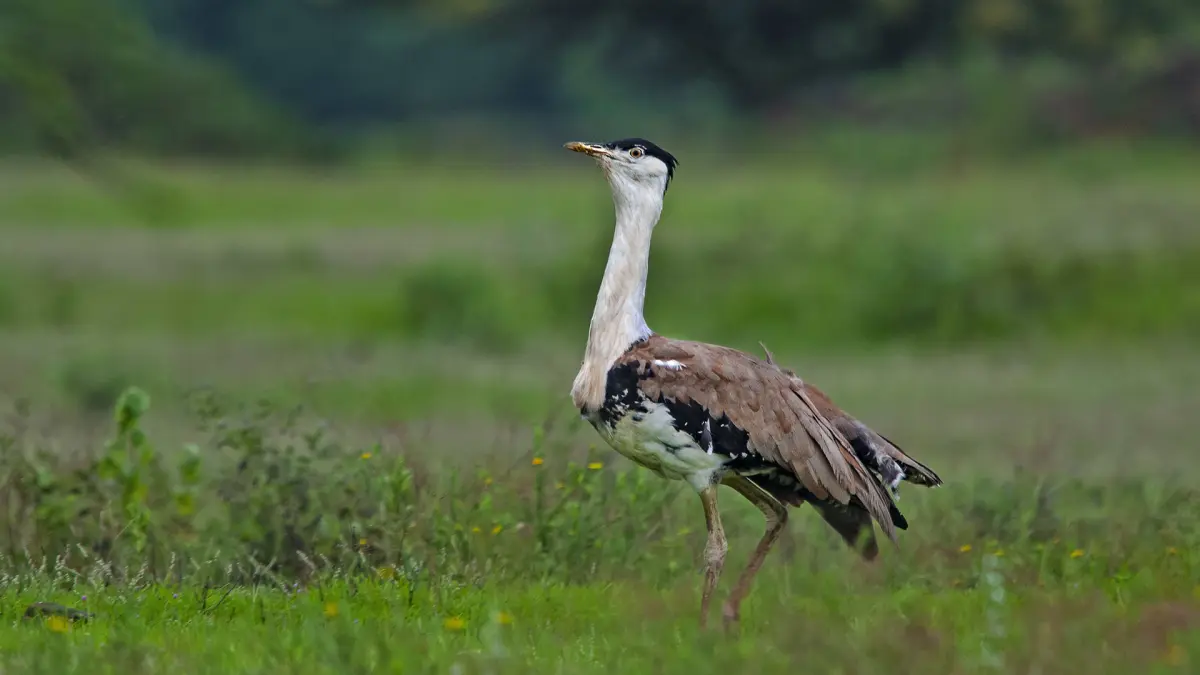
Key Points:-
- The first interstate JumpStart initiative for the conservation of the Great Indian Bustard (GIB) in the country.
- The interstate JumpStart initiative was coordinated by the Ministry of Environment, Forest and Climate Change (MoEFCC) in collaboration with the State Forest Departments of Rajasthan and Gujarat and the Wildlife Institute of India.
- The number of birds at conservation breeding centers in Sam and Ramdevra, Rajasthan, has increased to 73.
- A fertile egg was transported from Sam in Rajasthan to Naliya in Gujarat, a distance of 770 kilometers.
◦Only three females were left in Kutch, Gujarat, one of which had laid an infertile egg.
◦This infertile egg was replaced with a fertile egg, and a chick hatched from it.
About the Great Indian Bustard (GIB):-
- State bird of Rajasthan.
◦Also known as the Great Indian Bustard. - One of the four bustard species found in India.
◦The other three are the Lesser Florican, the Bengal Florican, and MacQueen's Bustard. - One of the heaviest flying birds in the world.
- Scientific name: Ardeotis nigriceps.
- Habitat: Currently, mainly in the Thar Desert in Rajasthan and partly in Gujarat, Maharashtra, Karnataka, and Andhra Pradesh.
Conservation status:-
- IUCN Red List: Critically Endangered.
- Convention on Migratory Species (CMS) Appendix 1
- CITES - Appendix 1
- Wildlife (Protection) Act, 1972 - Schedule I
Major Threats:-
- Habitat Loss and Fragmentation
- Overhead Power Transmission Lines
- Low Reproductive Rates
- Poaching and Stray Dogs
Conservation Efforts:-
'Project Great Indian Bustard' launched by the Government of Rajasthan
on June 5, 2013.
Great Indian Bustard Captive Breeding Program
- Launched in partnership between the Ministry of Environment, Forest
and Climate Change (MoEFCC), the Rajasthan Forest Department, and
the Wildlife Institute of India (WII). - Technical assistance from the International Fund for Houbara
Conservation (Abu Dhabi). - Establishment of conservation breeding facilities in Sam and Ramdevra,
Jaisalmer, Rajasthan. - The first Great Indian Bustard (GIB) chick was born through artificial
insemination (AI) at the Sudasari Breeding Centre in Jaisalmer,
Rajasthan in October 2024. - The Government of India has declared important habitats of the Great Indian Bustard as National Parks/Sanctuaries for their better protection.
‣ Desert National Park (DNP) – Jaisalmer and Barmer.
‣ Naliya Sanctuary, Gujarat.
‣ Karera Wildlife Sanctuary, Madhya Pradesh.
‣ Nannaj Grasslands, Solapur (Maharashtra). - Included under the Species Recovery Programme of the Ministry of Environment, Forest and Climate Change (MoEFCC), Government of India.
‣ Financial and technical assistance is provided to State/Union Territory Governments for better conservation of the Great Indian Bustard and its habitat. - A program titled 'Habitat Improvement and Conservation Breeding of the Great Indian Bustard - An Integrated Approach' was approved in 2016 with an outlay of ₹33.85 crore with financial support from CAMPA.
- Supreme Court Guidelines
‣ Released in December 2025.
• Revised Priority Areas (RPA)
◦14,013 square kilometers in Rajasthan and 740 square kilometers in Gujarat.
• No new solar parks and no new wind turbines with a capacity exceeding 2 MW will be permitted within the priority areas.
• Overhead power lines will be undergrounded/rerouted/insulated.
Watch Full Video👇:-
GIB Explained: India’s Critically Endangered Bird Click Here👈