
CONSTITUTIONAL BASIS & BACKGROUND
- ArticlesArticle 244(2) — applies Sixth Schedule to tribal areas of Assam, Meghalaya, Tripura, and Mizoram.
- Article 275(1) — grants-in-aid to states with Sixth Schedule areas.
- OriginBased on recommendations of the Bordoloi Committee (1947), chaired by Gopinath Bordoloi — first CM of Assam. Enacted to protect the rights, culture, and customs of tribal peoples of Northeast India.
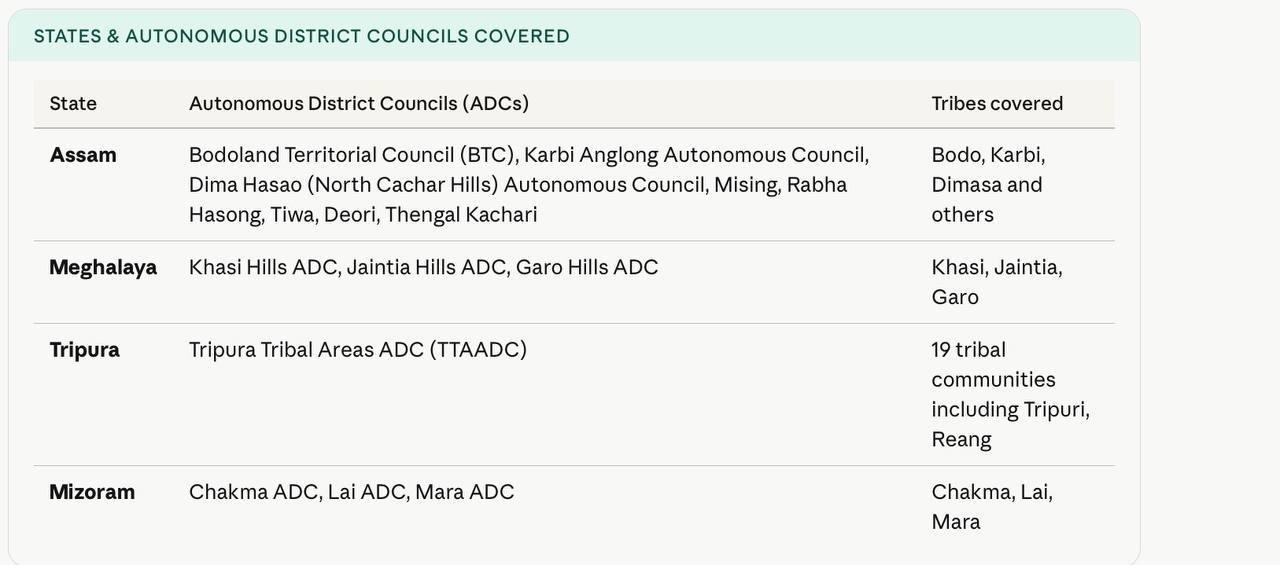
POWERS OF AUTONOMOUS DISTRICT COUNCILS — 4 DIMENSIONS
1. Legislative powers
- Can make laws on: management of land (other than reserved forests), use of waterways and rivers, regulation of shifting cultivation (jhum), establishment of village/town administration, money lending to tribals, social customs. Require assent of Governor to have effect.
2. Judicial powers
- Can establish District Council Courts and Regional Council Courts to try cases involving tribals (except those punishable by death or transportation or more than 5 years imprisonment). Acts as court of appeal over village courts. High Court has jurisdiction over these courts.
3. Executive powers
- Management of primary schools, dispensaries, markets, fisheries, roads, waterways within the district. Can also regulate money lending and trading by non-tribals. Establishment and management of ferries.
4. Financial powers
- Assess and collect land revenue; levy taxes on land, buildings, and entry of goods into area; impose tolls on roads and ferries. Receive grants-in-aid from Consolidated Fund of India under Article 275(1).
STRUCTURE OF ADC — COMPOSITION & ORGANISATION
1. ≤30 Members in each ADC — not more than 4 can be nominated by the Governor; rest are directly elected
2. 5 yrs Term of elected members of ADC — subject to dissolution by Governor on recommendation of state government
3. Governor Assent required for ADC laws; Governor can annul or suspend ADC regulations; can dissolve ADC
4. Regional If a tribe inhabits two or more districts, a Regional Council can be created — separate from the ADC
IMPORTANT COMMITTEES & COMMISSIONS
1. Bordoloi Committee (1947) Recommended the Sixth Schedule framework; Gopinath Bordoloi was its chairman and the first CM of Assam.
2. Shillong Accord (1972) Led to creation of Meghalaya and transfer of its ADCs (Khasi, Jaintia, Garo Hills) from Assam to the new state — both under the Sixth Schedule.
3. Dilip Singh Bhuria Committee (2002–04) Recommended extension of PESA-type provisions to Fifth Schedule areas; also reviewed tribal governance — relevant for comparison.
4. Bodo Peace Accord (2020) Resolved long-standing Bodo insurgency; reaffirmed and strengthened the Bodoland Territorial Council under a modified Sixth Schedule framework.
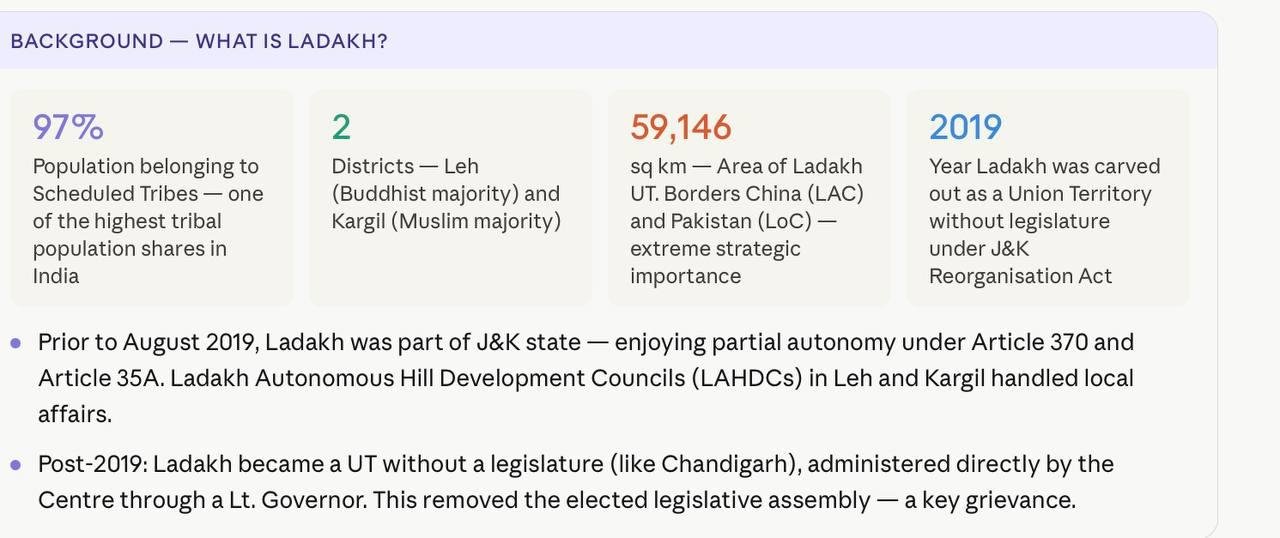
The Ladakh Issue — Statehood & 6th Schedule Demand-
CORE DEMANDS — 4 PILLARS
1. Full Statehood
- Restoration of elected state legislature — so Ladakhis can make their own laws on land, jobs, culture, and ecology. Proposed: The State of Ladakh Act, 2025 (draft submitted to MHA Nov 2025).
2. 6th Schedule status
- Inclusion under the Sixth Schedule to form Autonomous District Councils with legislative, judicial, and financial powers — protecting tribal land, culture, and customs. Proposed: Constitution 129th Amendment Act, 2025 (draft).
3. Separate Lok Sabha seats
- Demand for separate Lok Sabha constituencies for Leh and Kargil — currently both districts share one Lok Sabha seat (Ladakh constituency). Seen as inadequate representation for two distinct communities.
4. Public Service Commission
- Demand for a separate Ladakh Public Service Commission for recruitment to state-level posts — instead of being dependent on UPSC or JKPSC, which don't adequately represent Ladakh's conditions.
WHY THESE DEMANDS? — ROOT CAUSES
1. Land rights fearWithout 6th Schedule or state legislature, there are no constitutional safeguards against outsiders buying land in Ladakh. People fear demographic change and loss of tribal land — similar to what Article 35A used to prevent in J&K.
2. Employment fearFear that government jobs will go to outsiders without domicile protection. Demanded and partially addressed by Ladakh Reservation (Amendment) Regulation 2025 — 85% reservation for local residents with 15-year domicile criterion.
3. Cultural identityRich Buddhist and Islamic heritage; unique languages (Bhoti, Purgi, Shina, Balti) — fear of cultural erasure without constitutional protection. 97% tribal population deserves tribal protections.
4. Ecological fragilityLadakh is a high-altitude cold desert — extremely fragile ecosystem. Unregulated development and outsider-led commercial activities threaten glaciers, wetlands, and biodiversity. 6th Schedule would give locals control over land use.
5. Democratic deficitAs a UT without a legislature, Ladakhis have no elected body to make laws — all decisions taken by Lt. Governor (centrally appointed) or Parliament. Seen as a democratic regression after having an elected assembly within J&K.