
Introduction
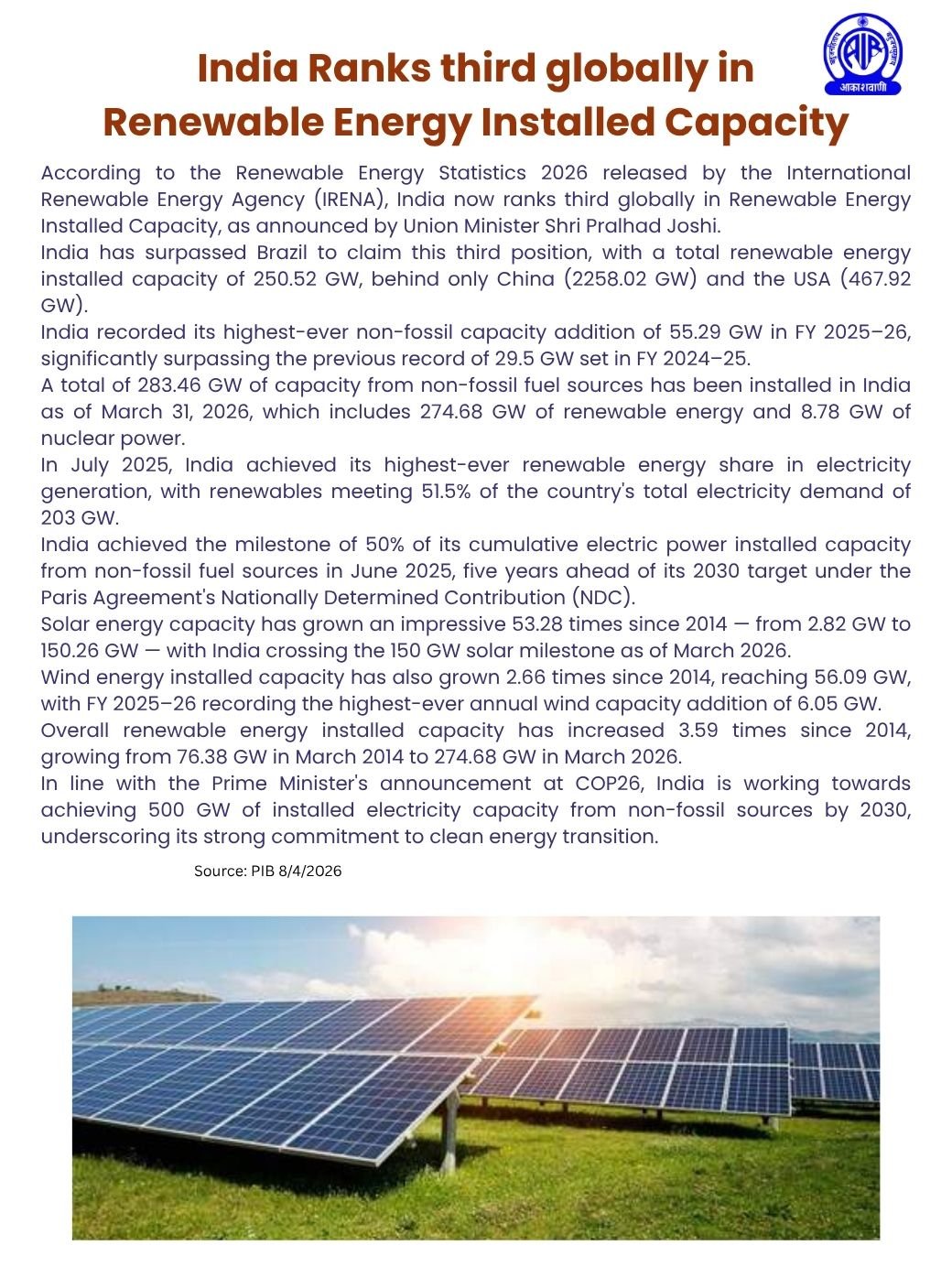
India has achieved a major milestone in the renewable energy sector by securing the third position globally in renewable energy installed capacity, according to the Renewable Energy Statistics 2026 released by the International Renewable Energy Agency (IRENA). This reflects India’s rapid progress in clean energy transition and commitment towards sustainable development.
---
Key Highlights (Facts & Data)
- India ranks 3rd globally, behind:
- China (2258.02 GW)
- USA (467.92 GW)
- India’s renewable energy installed capacity: 250.52 GW
- Total non-fossil fuel capacity: 283.46 GW
- Renewable energy: 274.68 GW
- Nuclear energy: 8.78 GW
- Highest-ever annual addition: 55.29 GW in FY 2025–26
- Renewable energy share in electricity generation: 51.5% (July 2025)
---
Growth Trends
Solar Energy
- Increased 53.28 times since 2014
- From 2.82 GW → 150.26 GW (March 2026)
Wind Energy
- Increased 2.66 times since 2014
- Reached 56.09 GW
- Highest annual addition: 6.05 GW (FY 2025–26)
Overall Renewable Growth
- Increased 3.59 times since 2014
- From 76.38 GW (2014) → 274.68 GW (2026)
---
Major Achievements
- India crossed 50% non-fossil fuel installed capacity in June 2025
- Achieved this 5 years ahead of 2030 target under Paris Agreement (NDC)
- Rapid expansion of solar and wind energy
---
Government Initiatives Driving Growth
- National Solar Mission
- Green Hydrogen Mission
- Production Linked Incentive (PLI) for solar modules
- Renewable Purchase Obligations (RPO)
- International Solar Alliance (ISA)
---
Target for Future
- Achieve 500 GW non-fossil fuel capacity by 2030
- Strengthen clean energy transition
- Reduce carbon emissions intensity
---
Significance for India
1. Energy Security
Reduced dependence on fossil fuels
2. Climate Commitments
Supports India’s NDC targets under Paris Agreement
3. Economic Growth
Boosts green jobs and investments
4. Global Leadership
India emerges as a major player in renewable energy
---
- Grid integration issues
- Storage infrastructure cost
- Land acquisition
- Financing requirements
- Intermittency of renewables
---
UPSC / RAS Exam Relevance
Important for:
- Environment & Ecology
- Climate Change
- Energy Security
- Sustainable Development
- Government Schemes
- International Organizations (IRENA)
---
Conclusion
India’s rise to the third position globally in renewable energy installed capacity marks a significant step towards sustainable development and climate leadership. While challenges remain, continued policy support, technological advancement, and investment will be key to achieving the ambitious 500 GW target by 2030.
---