
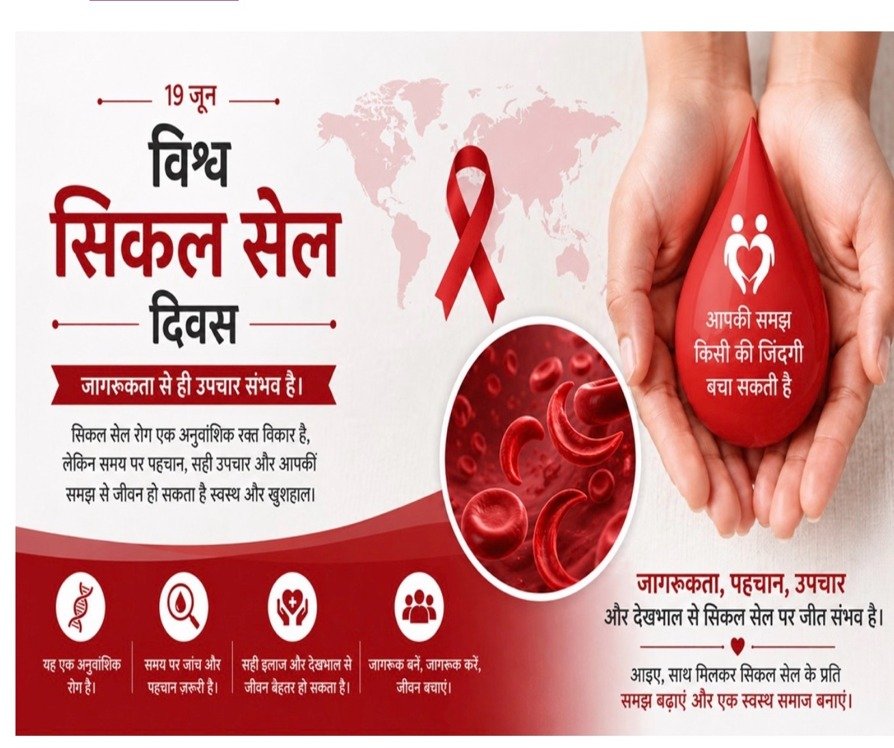
- Sickle Cell Disease (SCD) is a genetic disorder causing crescent-shaped, rigid red blood cells that block blood flow. It leads to complications like severe pain, swelling, anemia, infections, and organ damage (heart, liver, kidneys). The lifespan of affected individuals is significantly shortened, averaging 40 years.
|
Feature |
Normal RBCs |
Sickle Cells |
|
Shape. |
Biconcave disc (round, flexible) |
Crescent/sickle-shaped (rigid) |
|
Lifespan |
120 days |
10–20 days |
|
Function |
Flow freely; carry oxygen efficiently |
Block small blood vessels |
|
Result |
Normal oxygen delivery |
Pain crisis, organ damage, anaemia |
Symptoms & Complications -
Acute (immediate) complications:
- Vaso-occlusive crisis (pain crisis) - Sudden intense pain in bones, chest, back, arms, legs most common symptom.
- Acute Chest Syndrome - Life-threatening fever, chest pain, breathing difficulty.
- Splenic sequestration - Blood pools in spleen cause severe anaemia.
- Stroke - Blocked blood vessels in brain.
Chronic (long-term) complications-
- Chronic anaemia: leading to fatigue, weakness, and paleness. Painful episodes (sickle cell crisis) in bones, chest, back, arms, and legs.
- Progressive organ damage heart, liver, kidneys, eyes.
- Pulmonary hypertension.
- Leg ulcers, Avascular necrosis (bone death), Immune deficiency frequent infections
India Burden -
♦ More than 1 crore people have sickle cell trait (carriers) in India.
♦ Over 1 million people in India are affected by SCD.
♦ Predominantly affects Scheduled Tribe populations highest prevalence in tribal belts.
♦ High-burden states - Odisha, Chhattisgarh, Madhya Pradesh, Maharashtra, and Gujarat together account for an estimated 95% of all confirmed cases nationally.
♦ Other affected states- Rajasthan, Gujarat, Telangana, Karnataka, Uttarakhand, Andhra Pradesh, Tamil Nadu, Kerala, Assam.
♦ Tribal communities most affected - Gond, Bhil, Munda, Oraon, Kondh, Saura, and other indigenous communities across central and eastern India.
Treatment Options
- Blood Transfusions- Can help relieve anaemia and reduce the risk of pain crises.
- Hydroxyurea - A medication that can help reduce the frequency of painful episodes and prevent some of the long-term complications of the disease. It can also be treated by bone marrow or stem cell transplantation.
|
Treatment |
Nature |
Access |
|
Hydroxyurea |
Oral drug reduces pain crises frequency, increases HbF (foetal haemoglobin) |
Most accessible; recommended first-line |
|
Blood transfusion |
Regular transfusions reduce anaemia |
Available at secondary/tertiary care |
|
Bone marrow transplant |
Potentially curative replaces defective stem cells |
Expensive; limited availability; requires matched donor |
|
Stem cell therapy |
Emerging curative approach |
Research stage in India |
|
Gene therapy / CRISPR |
Cutting-edge corrects the defective gene |
Clinical trials; not yet widely available |
|
Voxelotor |
New drug (FDA approved 2019) prevents sickling |
Very expensive; limited access in India |
|
L-glutamine |
Reduces acute complications |
Approved in some countries |
National Sickle Cell Anaemia Elimination Mission (NSCAEM) –
Vision -To eliminate sickle cell disease as a public health problem in India before 2047.
Vision -To eliminate sickle cell disease as a public health problem in India before 2047.
Key features of the Mission
- Universal screening of tribal population (0-40 years).
- Pre-marital and pre-conception counselling to prevent birth of affected children.
- Digital health cards for screened individuals.
- Real-time monitoring through National Sickle Cell Portal .
- Large-scale screening has improved early identification of patients and carriers, while awareness campaigns and counselling initiatives have increased community-level awareness about genetic disorders.
- The mission has also strengthened data collection and coordination through digital health cards and real-time monitoring systems.
Conclusion -
- Achieving the 2047 goal requires a multi-pronged approach involving diagnosis, treatment, awareness, and research, with active participation from all stakeholders. Specifically: expand hydroxyurea access at sub-district level; strengthen pre-marital genetic counselling in tribal communities; develop affordable gene therapy pathways; leverage CRISPR research partnerships (India-US iCET framework); integrate SCD screening with PM-WANI and Ayushman Bharat Arogya Mandirs; build community health worker (ASHA/CHO) capacity in tribal areas for sustained follow-up.