
Biodiversity types –
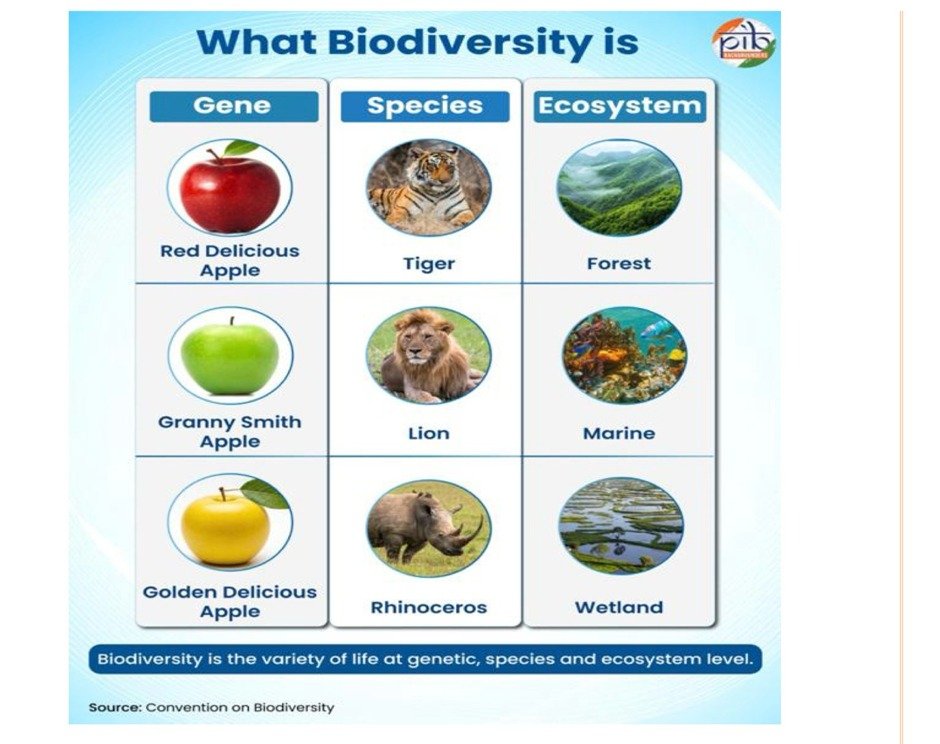
- Gene is considered the basic unit of inheritance. Genes are passed from parents to offspring and contain the information needed to specify physical and biological traits.For example, Red Apple, Granny Smith Apple, and Golden Apple are different genetic varieties of apples.
- Species is a group of organisms that can successfully breed to produce fertile offspring. This species definition divides up animals, plants and other forms of life into groups based on their reproduction. For example, the tiger, lion, and rhinoceros are different animal species.
- Ecosystem is a geographic area where plants, animals and other organisms, as well as weather and landscape, work together to form a life. Ecosystems contain living factors, as well as non-living factors. living factors include plants, animals and other organisms. non-living factors include rocks, temperature and humidity
KEY facts for mains
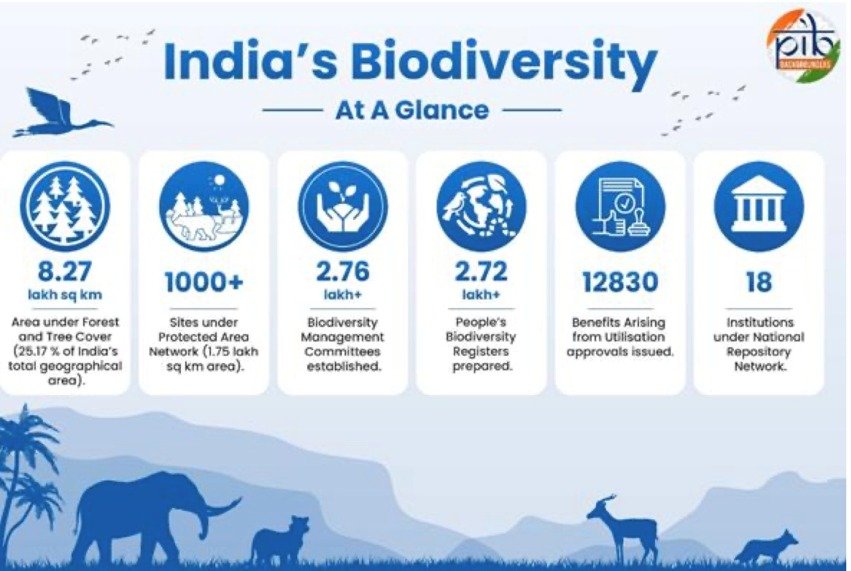
- 8.27L km² Forest & tree cover (25.17% of India).
- 1134+ Protected areas (1.88L km²).
- 2.76L+ Biodiversity Management Committees.
- 2.72L+ People's Biodiversity Registers.
- 3,682 Tigers (up from 2,226 in 2014).
- 12,830 ABS approvals (2017–2026).
- ₹145 Cr Released to ABS beneficiaries (as of May 2026).
- 18 Institutions under National Repository Network.
THREE-TIER GOVERNANCE STRUCTURE (BIOLOGICAL DIVERSITY ACT, 2002)
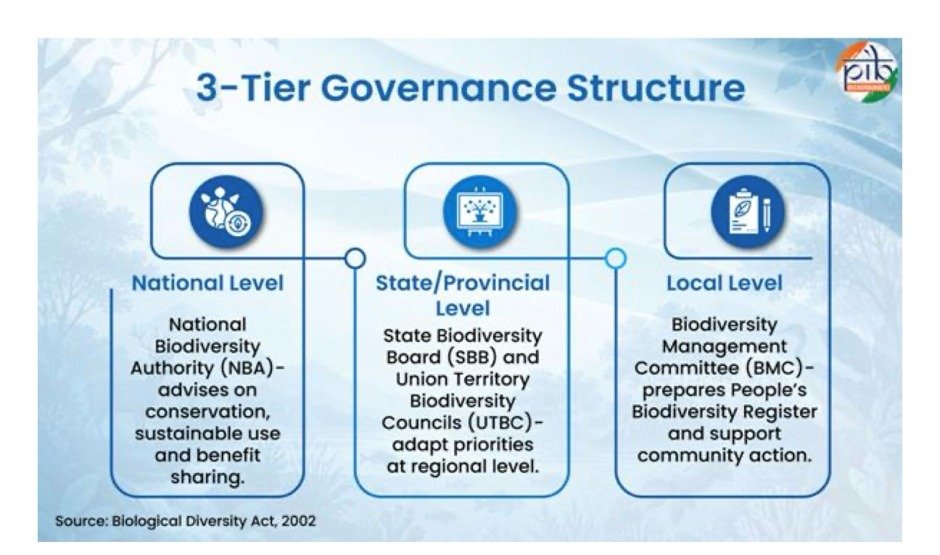
- National Level National - Biodiversity Authority (NBA) — advises on conservation, sustainable use & benefit sharing.
- State/UT Level - State Biodiversity Boards (SBB) + UT Biodiversity Councils (UTBC) — adapt priorities regionally.
- Local Level - Biodiversity Management Committees (BMC) — prepare People's Biodiversity Registers (PBR), support community action.
LEGAL FRAMEWORKS
Biological Diversity Act, 2002
- Principal legal framework
- Covers conservation, sustainable use & fair benefit sharing. Provides statutory basis for 3-tier governance. Protects traditional knowledge & biological resources.
Amendment Act, 2023
- Strengthened framework
- More facilitative implementation; supports research, innovation & TK-based practices; improves compliance & governance efficiency; reinforces community participation.
Section 39, Biological diversity act
- National Repositories
- Empowers Central Govt to designate 20+ institutions as repositories. Any new taxon discoverer must deposit voucher specimens here.
Section 27, BD Act
- NBAF (National Biodiversity Authority Fund)
- Statutory fund for benefit sharing and conservation-related use.
INTERNATIONAL COMMITMENTS
- CBD (Convention on Biological Diversity) India's 7th National Report (NR-7) submitted to CBD — indicator-based assessment of policies, targets & actions.
- Nagoya Protocol (COP-10, 2010) Legally binding; ensures fair & equitable sharing of benefits from genetic resources & traditional knowledge. India submitted its 1st National Report on implementation.
- KMGBF (Kunming-Montreal GBF) Adopted at COP-15 (Dec 2022), co-chaired by China & Canada. 196 nations goal halt & reverse biodiversity loss by 2030 "living in harmony with nature" by 2050.
- NBSAP 2024–2030 National Biodiversity Strategy & Action Plan — aligned with KMGBF. Whole-of-government & whole-of-society approach.
KEY INSTRUMENTS & INITIATIVES
- People's Biodiversity Register (PBR) - Local biodiversity database records species, habitats, landraces, folk varieties, domesticated stocks, microorganisms & traditional knowledge. 2,72,648 registers prepared. National campaign to digitise → ePBRs.
- ABS e-filing Portal (launched 2017) -Access & Benefit Sharing portal. Online application, transparent processing, faster approvals.
- BIOFIN-India (2015) - Biodiversity Finance Initiative linked to UNDP's BIOFIN framework. Identifies funding needs & mobilises resources for conservation. Planning tool (BIOFIN) , statutory mechanism (NBAF) work together.
- National Red List Roadmap (2025–30) Led by ZSI & BSI with IUCN-India. Establishes nationally coordinated threatened-species assessment system. Aligned with KMGBF goal of improving species status assessments by 2030.