
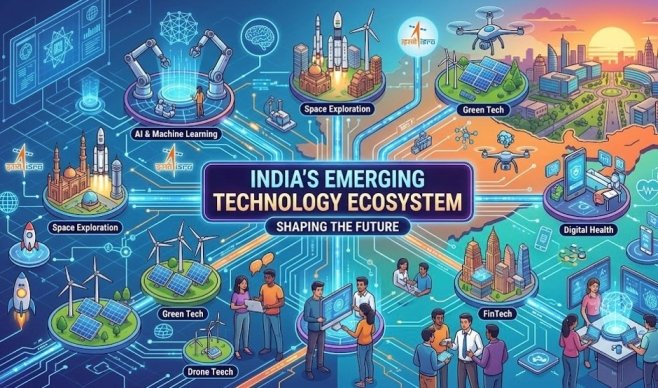
India has shifted from a large digital consumer market to an emerging global technology power over the past decade. The transformation rests on three pillars-
- Capacity- digital infrastructure, skilling, R&D.
- Capability- mission-mode programmes in AI, semiconductors, quantum, supercomputing, blockchain, cloud, biotech.
- Credibility- trusted DPI, secure governance, global tech partnerships.
Digital Infrastructure - The Foundation Backbone –
The Digital India Programme (Launched 2015)
- Optical Fibre Expansion- Route coverage increased from 19.35 lakh km (2019) to 42.36 lakh km (2025).
- Telecom Revolution-
- 5G services reached 99.9% of districts via one of the world's fastest rollouts.
- Internet connections soared from 25.15 crore (2014) to 102.86 crore (2026).
- Broadband connections jumped from 6.1 crore (2014) to 99.56 crore (Dec 2025).
- Data Affordability & Consumption-
- Average monthly data consumption grew from 61.66 MB (2014) to 24.01 GB (Dec 2025).
- Wireless data costs plummeted from ₹269 per GB (2014) to ₹8–10 per GB (2026).
Pillar-Wise Critical Technology Missions
A. High-Performance Computing (HPC)
- National Supercomputing Mission (NSM, 2015)- Launched with a ₹4,500 crore outlay; deployed 38 supercomputers (combined 47 petaflops) across premier institutions.
- Indigenization- Developed the PARAM Rudra series utilizing indigenously designed hardware and software to promote self-reliance.
B. Semiconductor Ecosystem
- Semicon India Programme (2021) - Outlay of ₹76,000 crore targeting manufacturing, display fab, chip design, packaging, and testing.
- ISM 2.0 (Union Budget 2026-27)- Outlay of ₹1,000 crore focusing on equipment, raw materials, resilient supply chains, and advanced manufacturing.
- Design Linked Incentive (DLI) Scheme (2021)- Financial incentives for fabless startups/MSMEs. Status (as of March 2026)- 24 companies received fiscal support; 7 chips fabricated from 16 tape-outs (including advanced 12 nm designs).
- Current Footprint- 12 projects approved worth ₹1.64 lakh crore (1 semiconductor fab, 2 compound semiconductor fabs, 9 packaging units).
C. Quantum Technology
- National Quantum Mission (NQM)- Outlay of ₹6,003.65 crore focusing on four verticals-
01. Quantum Computing, 2. Quantum Communication, 3. Quantum Sensing and Metrology, and 4. Quantum Materials and Devices. - Key Achievements-
- Established 4 Thematic Hubs across leading institutions.
- Supported 17 startups (including 9 deep-tech ventures).
- Demonstrated a 1,000-km secure quantum communication network .
- Foundation stone of India's first Quantum Valley laid in Amaravati.
D. Artificial Intelligence (AI)
- IndiaAI Mission (2024)- Approved with an outlay exceeding ₹10,300 crore to build indigenous GPU computing infrastructure (targeting a common facility with over 38,000 GPUs).
- AI Ecosystem Data- As of March 2026, India has 1.8 lakh startups, with nearly 89% of new startups deploying AI solutions.
- AI Kosh Platform- Hosts 12,115 datasets and 306 AI models across 20 sectors to democratize access.
E. Cloud and Blockchain Platforms
- MeghRaj (National Cloud Platform)- upgraded to MeghRaj 2.0 (hybrid cloud architecture & enhanced cybersecurity). Adoption rose from 342 government departments (2015-16) to 2,323 departments by June 2026 (powering DigiLocker, MyGov, etc.).
- Fiscal Incentives (Budget 2026-27)- Tax holidays till 2047 for cloud/AI infrastructure, 15% safe harbour provisions, and increased safe harbour eligibility threshold from ₹300 crore to ₹2,000 crore.
- National Blockchain Framework (NBF, 2021)- Outlay of ₹64.76 crore. Indigenous stacks include Vishvasya Blockchain Stack, NBFLite sandbox, and Praamaanik app.
- Data Centers- Capacity expanded drastically from 375 MW (2020) to nearly 1,500 MW (2025), with key hubs in Mumbai, Navi Mumbai, Hyderabad, Bengaluru, Noida, and Jamnagar.
F. Biotechnology & Bioeconomy
- Growth- The sector grew USD 190 billion.
- Key Policies & Interventions- National Biopharma Mission, BioE3 Policy (2023).
Human Capital, Research, and Skilling
- Anusandhan National Research Foundation (ANRF, 2024)- Operates key translational programs: PAIR (Partnerships for Accelerated Innovation and Research), .
- Research Development and Innovation (RDI) Scheme- A ₹1 lakh crore corpus under ANRF providing long-term, affordable financing for private-sector research in deep-tech, AI, and advanced manufacturing.
- Indian Institutes of Skills (IIS)- First phase became operational in Mumbai and Ahmedabad (Oct 2024)under a PPP model with Tata IIS, targeting Industry 4.0-ready skills.
- FutureSkills PRIME (2018)- MeitY-NASSCOM venture for digital upskilling. with 80% coming from Tier-2 and Tier-3 cities.
- SOAR (Skilling for AI Readiness)- Targets schools (Classes 6-12) with modular AI literacy via the Skill India Digital Hub (SIDH), which boasts over 1.5 crore registered candidates.
- Chips to Start-up (C2S) Programme (2022)- ₹250 crore outlay to train 85,000 industry-ready professionals in VLSI/ASIC/SoC design. Established the ChipIN Centre at SCL Mohali for shared wafer runs.
Global Credibility, Diplomacy, and Indices-
International Rankings
- Global Innovation Index (GII)- India's rank improved from 81st (2015) to 38th (2025).
- Network Readiness Index (NRI)- India jumped from Rank 91 (2016) to Rank 45 (2025).
Global Footprint & Tech Diplomacy
- Global Capability Centres (GCCs)- India hosts over 2,100 GCCs (spanning 3,728 units), employing 2.36 million professionals. Nearly half of the GCCs set up since 2021 are AI-focused.
- Bharat 6G Alliance (B6GA)- Drives indigenous 6G R&D and global standardization forum partnerships (with US, EU, UK, Japan, South Korea, Brazil).
- NEST Division (New, Emerging and Strategic Technologies)- Set up in 2020 under the Ministry of External Affairs (MEA) to handle foreign policy, international law, and technology diplomacy for 5G, AI, biotech, and semiconductors.
- Pax Silica- A strategic coalition of democratic nations working to secure the entire "silicon stack" (critical minerals to advanced AI deployment) to counter supply chain overconcentration and economic coercion. India formally joined the coalition in February 2026 during the India AI Impact Summit.
- DPI & India Stack Diplomacy: India has signed agreements with 23 countries for cooperation on Digital Public Infrastructure. UPI is now operational in countries including Singapore, UAE, France, Nepal, and Sri Lanka.
- Key Global Convenings Hosted-
- SEMICON India 2025 - Led to the signing of 13 major MoUs.
- India AI Impact Summit 2026 -Generated over USD 200 billion in AI-related investment commitments and saw the adoption of the India AI Impact Summit Declaration by 92 countries/organizations.