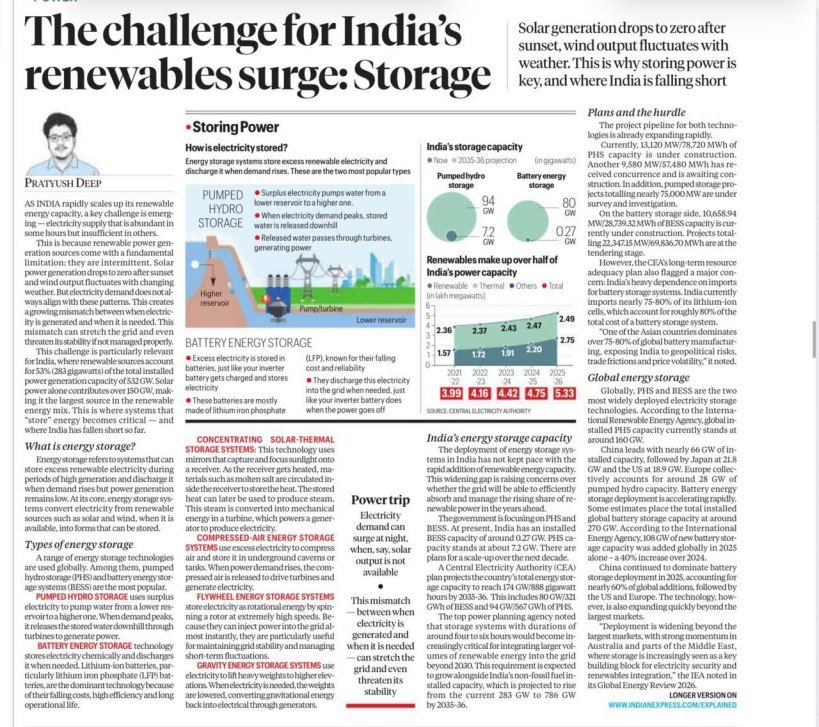
1. The Context & The Core Problem
- The Mismatch: RE sources are inherently intermittent (solar drops after sunset, wind fluctuates). Peak electricity demand often surges at night when solar is zero.
- Grid Threat: This mismatch between generation and consumption stretches the grid and threatens stability.
- India's Status: RE now makes up >50% (283 GW) of India's total installed capacity (532 GW). Solar is the largest chunk (>150 GW). Without storage, much of this RE potential is wasted.
2. Types of Energy Storage Technologies
- Pumped Hydro Storage (PHS): Uses surplus electricity to pump water to a higher reservoir. During peak demand, water is released downhill through turbines.
- Battery Energy Storage Systems (BESS): Chemical storage. Lithium-iron phosphate (LFP) batteries are currently dominant due to falling costs, reliability, and long life.
Concentrating Solar-Thermal: Mirrors focus sunlight onto a receiver -> heats materials like molten salt -> heat used to produce steam -> runs a turbine.
- Compressed-Air Storage: Surplus power compresses air in underground caverns/tanks -> released later to drive turbines.
- Flywheel Storage: Stores electricity as rotational energy (spinning a rotor at high speeds). Injects power instantly -> excellent for short-term grid stability and managing fluctuations.
- MGravity Storage: Uses electricity to lift heavy weights -> weights are lowered when power is needed, converting gravitational energy back to electrical.
3. India's Current Capacity vs Targets (CEA Projections)
- Current Reality (Lagging behind): Storage deployment has not kept pace with RE addition.
o Current PHS: ~7.2 GW
o Current BESS: ~0.27 GW
- 2035-36 Targets (Massive scale-up needed):
o PHS Target: 94 GW
o BESS Target: 80 GW
o Total target: 174 GW of storage.
Requirement: Central Electricity Authority (CEA) notes that storage durations of 4-6 hours will be critical to integrate the projected 786 GW of non-fossil capacity by 2035-36.
4. Key Hurdles & Vulnerabilities
- Extreme Import Dependency: India imports 75-80% of its Lithium-ion cells (mostly from one Asian country - i.e., China).
- Cost Factor: The cells alone account for ~80% of the total cost of a battery storage system.
- Strategic Risk: This heavy reliance exposes India's energy transition to geopolitical risks, trade frictions, and severe price volatility.
5. Global Landscape
- PHS: Global installed capacity is ~160 GW. China leads (~66 GW), followed by Europe, Japan, and the US.
- BESS: Accelerating rapidly. Total installed is ~270 GW. China accounted for nearly 60% of all global battery storage additions in 2025. Expanding fast in Australia and the Middle East.