THREE PILLARS OF INDIA'S SPACE TRANSFORMATION
- India's Space Capability - landmark missions, advanced launch systems, indigenous technologies.
- Building National Capacity - governance, connectivity, disaster management, agriculture, healthcare, education.
- Global Partnerships & Collaborative Leadership - trusted space partner, 300+ cooperation agreements.
Policy Frameworks & Structural Reforms -
- Opening the Sector (2020) - Shifting the space domain from a government monopoly to a vibrant, private-player-inclusive national ecosystem.
- Institutional Single-Window Mechanisms-
- NSIL (NewSpace India Limited - Est. 2019) - Handles commercialization of ISRO's technologies, launch services, and satellite services.
- IN-SPACe (Est. 2022) - Facilitates and authorizes private-sector activities. Introduced the Norms, Guidelines and Procedures (NGP) 2024 to bring regulatory clarity and investor confidence.
- Financial & Incubation Incentives- Implemented the Indian Space Policy 2023, the IN-SPACe Seed Fund Scheme, a Pre-incubation Entrepreneurship (PIE) Program, a ₹1,000 crore Venture Capital Fund, and a ₹500 crore Technology Adoption Fund (TAF).
- Liberalized FDI Policy (2024)-
- Up to 100%- Automatic route for manufacturing satellite and ground-segment components/subsystems.
- Up to 74%- Automatic route for satellite manufacturing/operations and data products.
- Up to 49%- For launch vehicles, spaceports, and related systems.
- Startup Boom - Pioneers include Pixxel, Dhruva Space, Skyroot Aerospace, Agnikul Cosmos, and Bellatrix Aerospace.
Deep-Space Exploration & Flagship Missions
- The Chandrayaan Programme (Lunar Missions)
- Chandrayaan-1 (2008) - Discovered evidence of water molecules and hydroxyl on the Moon's surface.
- Chandrayaan-2 (2019)- High-resolution orbiter mapping (down to 30 cm resolution).
- Chandrayaan-3 (August 23, 2023) - Historic breakthrough making India the first country to soft-land near the Moon's south pole (69.3 S latitude) and the fourth nation globally to achieve a lunar soft-landing. Its payloads directly confirmed the presence of Sulphur.
- Chandrayaan-4 (Planned 2027)- Targeted lunar landing, sample collection, and an indigenous return mission to Earth.
- Chandrayaan-5 / LUPEX (Planned 2027-28)- Joint Lunar Polar Exploration mission with Japan (JAXA) to drill for water-ice deposits.
- Interplanetary & Solar Observatories-
- Mars Orbiter Mission / Mangalyaan (2014) - India became the first country to reach Mars on its maiden attempt. Outlived its 6-month design life to operate for over 8 years, studying the Martian atmosphere and solar winds.
- Aditya-L1 (2023) - India’s first dedicated solar observatory placed in a halo orbit at the Sun-Earth Lagrange Point 1 (L1), 1.5 million km from Earth. It provides continuous solar observation and has disseminated over 27 TB of public data.
- Venus Orbiter Mission (VOM - Planned March 2028)- Approved to study Venus' geology and atmosphere. It will test complex technologies for the first time, including aerobraking and advanced thermal management.
- Human Spaceflight & Orbital Infrastructure-
- Gaganyaan Programme & Axiom-4
- Core Objective - Approved in 2019 to send up to three Indian astronauts into a 400 km Low Earth Orbit (LEO) for up to 3 days. Consists of two uncrewed test flights and one final crewed mission.
- Axiom-4 Mission (2025) - Critical stepping stone where Group Captain Shubhanshu Shukla flew to the International Space Station (ISS) aboard a SpaceX Dragon capsule. Conducted 7 vital microgravity experiments covering muscle regeneration, crop viability, and microbial survivability, gaining operational crewed flight experience.
- Space Docking & Indigenous Space Station
- SPADEX (Space Docking Experiment)- Made India the 4th nation to master autonomous orbital docking/undocking. Successfully demonstrated power transfer and robotic arm operations in microgravity technologies vital for Chandrayaan-4 and space stations.
- Bharatiya Antariksh Station (BAS) - India’s planned 5-module space station in LEO. The Union Cabinet approved the development of the first gateway module, BAS-01, targeted for launch by 2028.
- Infrastructure & Indigenous Technological Stack
- Launch Vehicle Upgrades-
- Current Fleet Capability - PSLV, GSLV, and LVM3 provide independent access to launch up to 10 tons to LEO and 4.2 tons to Geo-Synchronous Transfer Orbit (GTO).
- Next Generation Launch Vehicle (NGLV) - Approved to handle heavier configurations up to 30 tons to LEO. Includes a partially reusable variant targeting a 14-ton LEO payload.
- Winged Upper Stage - Under development to allow autonomous runway landings back on Earth.
- RLV-TD (Reusable Launch Vehicle-Technology Demonstrator)- A flying testbed combining launch vehicle and aircraft complexities. Successfully tested in May 2016 from Sriharikota, it has completed three consecutive autonomous runway landing experiments.
- Expanding Launch Infrastructure
- Second Spaceport (Kulasekarapattinam, Tamil Nadu) - Small Satellite Launch Vehicle (SSLV) Complex approved to support 20-25 orbital launches annually, with the first launch slated for FY 2026-27.
- Third Launch Pad (Sriharikota) - Approved in January 2025 (₹3,984.86 crore) specifically to handle heavy next-gen vehicles, human flights, and lunar operations.
- Propulsion & Electronics Breakthroughs-
- Electric Propulsion Systems (EPS)- Extends satellite lifespans; first operational launch scheduled for FY 2026-27.
- CE20 Cryogenic Engine- Upgraded with Bootstrap Ignition Technology to enable multiple engine restarts in a vacuum.
- Vikas Engine- Achieved critical throttling capabilities, which are essential for vertical take-off and landing (VTOL) reusable rockets.
- Indigenous Computing- ISRO and the Semiconductor Laboratory (SCL), Chandigarh developed VIKRAM3201 (India's first fully indigenous 32-bit space microprocessor) and KALPANA32 to remove foreign component dependencies.
Space for Citizens & Data-Driven Governance
- NavIC (Navigation with Indian Constellation)
- Coverage Range- Provides precise positioning across India and up to 1,500 km beyond its borders to achieve strategic autonomy.
- Upgrades- Introducing second-generation satellites (NVS-01 launched May 2023; NVS-02 launched January 2025) across a planned 5-satellite tier (NVS-01 to NVS-05).
- Civilian Applications- Power-grid synchronization, real-time train tracking, vehicle monitoring, Aadhaar device geo-tagging, and chip integration via partnerships with Qualcomm. Signed a bilateral deal with South Africa in 2025 to set up a ground reference station abroad.
- Sectoral Applications & Geoportals
- Agriculture & Water Security- Crop acreage mapping, production forecasting, and drought assessment. Uses hydro-informatics through the National Hydrology Project and India-WRIS (Water Resources Information System).
- Disaster Management- Real-time hazard mapping via the National Database for Emergency Management (NDEM 5.0) and the Satellite Aided Search and Rescue (SASAR) alert program.
- Coastal Welfare- Potential Fishing Zone (PFZ) mapping to reduce fuel costs for fishermen, along with indigenous Distress Alert Transmitters (DATs) on vessels.
- Social Sectors (Health & Education)-
- Health- 179 operational telemedicine nodes (with ~80 in strategic, remote high-altitude regions like Leh, Ladakh, and Siachen).
- Education- PM e-VIDYA broadcasts 370 educational TV channels via GSAT-15 and GSAT-9 satellites.
- Specialized Geoportals- Platforms like Bhoonidhi, MOSDAC, VEDAS, and Bhuvan integrated with DIGIPIN for advanced digital mapping and infrastructure monitoring.
- Bilateral & Regional Space Diplomacy-
- Global Footprint Matrix - India has expanded its launches from 35 foreign satellites (1990s–2014) to 399 foreign satellites launched between 2014 and March 2026. India maintains over 300 agreements across 61 countries and 5 multilateral bodies.
|
Partner Country / Agency |
Initiative / Mission Name |
Strategic Domain & Key Deliverables |
|
BIMSTEC Block |
BIMSTEC Space Programme |
Leads regional disaster resilience under "Neighbourhood First" policy; NESAC (North Eastern Space Applications Centre) hosts satellite application training; operates BIMSTEC Centre for Weather and Climate. |
|
SAARC Block |
South Asia Satellite (GSAT-9) |
Launched in 2017 as an Indian-funded gift (₹450 crore) containing 12 Ku-band transponders for regional DTH, banking, and disaster relief. Note: Pakistan opted out, changing its name from SAARC to South Asia Satellite. |
|
USA (NASA) |
NISAR Mission(Launched July 2025) |
Dual-frequency Synthetic Aperture Radar launched on GSLV-F16 to track climate change, global land, cryosphere, and ocean dynamics. |
|
France (CNES) |
TRISHNA Mission(Planned 2026) |
High-resolution Thermal InfraRed Imaging Satellite to map crop water stress, urban ecosystems, and irrigation optimization. |
|
Russia (Roscosmos) |
Gaganyaan & Navigation |
Strategic MoU (2018) for astronaut training, life-support hardware, and crew safety mechanics. Historical links exist via Aryabhata (1975) and Rakesh Sharma (1984), extending to GLONASS-NavIC integration. |
|
Japan (JAXA) |
Chandrayaan-5 / LUPEX(2027-28) |
Joint lunar exploration incorporating an Indian lander and Japanese rover launched on an H3 rocket, hosting payloads from ESA and NASA. |
|
European Space Agency (ESA) |
Human Spaceflight Accord (May 2025) |
Joint Statement of Intent focusing on LEO and lunar systems interoperability, astronaut training, and future European integration on the BAS. |
|
Germany (DLR) |
Optical & Microgravity Expansion |
Strategic dialogue (June 2026) building on 11 historical German satellite launches to expand optical communications and drone tech integration. |
|
Italy (ASI) |
Joint Strategic Action Plan (2025-2029) |
Signed at the Rio G20 Summit (2024) to expand collaboration in heliophysics, earth observation, and joint private-sector space startup cross-flows. |
|
Saudi Arabia (SSA) |
Space Innovation MoU (April 2025) |
Focuses on joint academic engagement, exploration research, and commercial aerospace entrepreneurship. |
|
Mauritius (MRIC) |
Co-developed Small Satellite |
Signed MoU (2023) for an Indian-funded satellite (₹20 crore) realized within a 15-month timeframe to leverage Mauritius' tracking ground station. |
|
Bhutan |
Peaceful Outer Space MoU (2020) |
Covers joint working groups for developmental applications, Earth observation, and satellite-based governance. |
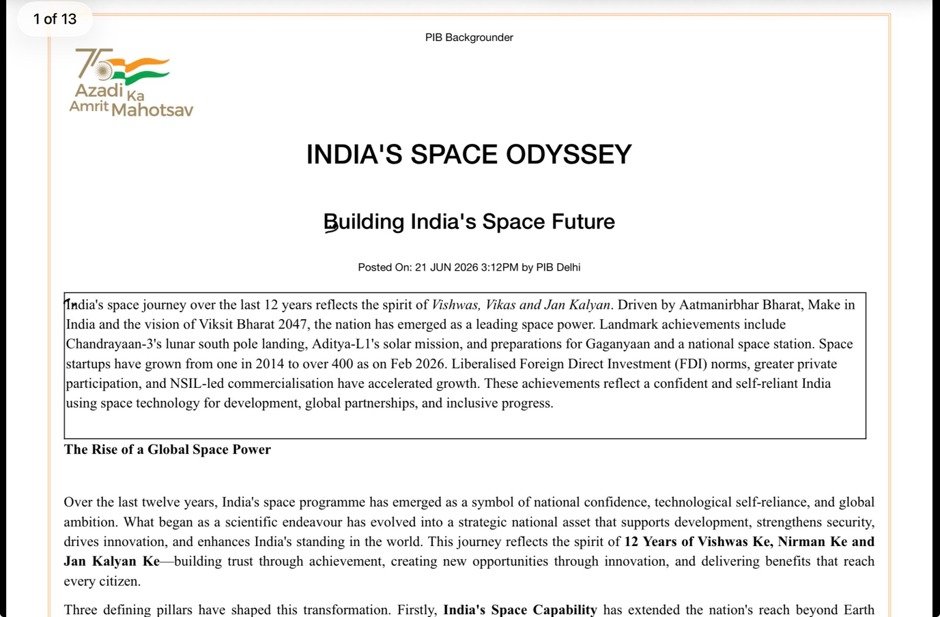
- India's space journey reflects the spirit of Vishwas, Vikas and Jan Kalyan. Driven by Aatmanirbhar Bharat, Make in India and the vision of Viksit Bharat 2047, the nation has emerged as a leading space power. Landmark achievements include Chandrayaan-3's lunar south pole landing, Aditya-L1's solar mission, and preparations for Gaganyaan and a national space station. Liberalised Foreign Direct Investment (FDI) norms, greater private participation, and NSIL-led commercialisation have accelerated growth. These achievements reflect a confident and self-reliant India using space technology for development, global partnerships, and inclusive progress.