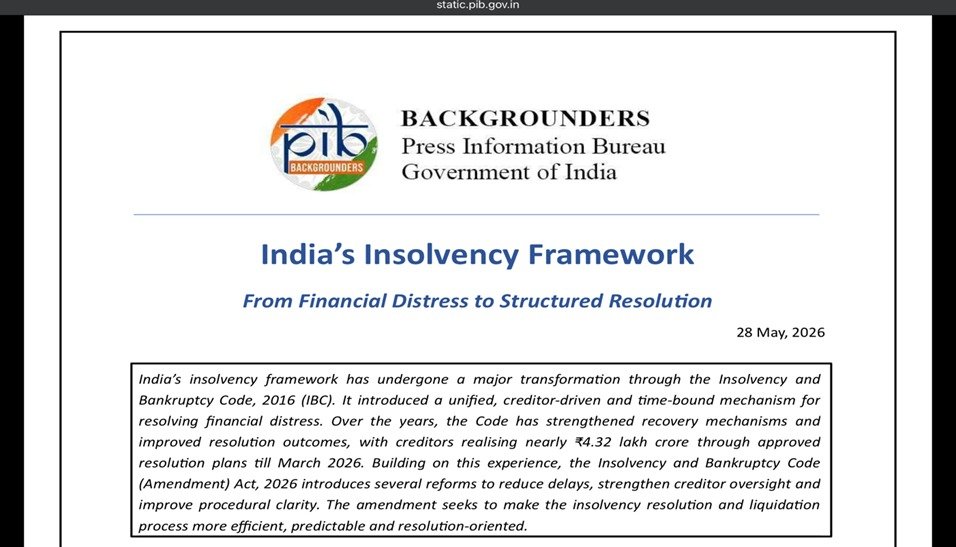
Administered ministry :-
- Ministry of Corporate Affairs.
Regulator:-
- IBBI (Insolvency and Bankruptcy Board of India).
- Main objective: "IBC introduced a unified, creditor-driven and time-bound mechanism for resolving financial distress — consolidating multiple overlapping frameworks into a single structure."
Data for answer enrichment-
- 94.56% -Recoveries as % of fair value under approved resolution plans
- 52.4% - Share of IBC in total bank NPA recoveries (2024-25) — highest among all recovery channels
| IBC FRAMEWORK — |
|
CIRP |
Corporate Insolvency Resolution Process — structured mechanism for resolving corporate insolvency. Timeline: 180 days (extendable to 330 days). If unresolved → liquidation. |
|
CoC |
Committee of Creditors — comprising financial creditors. Evaluates resolution plans; makes commercial decisions about the future of the stressed entity. Core decision-making body under IBC. |
|
IBBI |
Insolvency and Bankruptcy Board of India — apex regulatory authority. Oversees IPs, IPAs, Information Utilities. Frames regulations and standards for the insolvency ecosystem. |
|
IP |
Insolvency Professional — appointed to administer the affairs of the distressed entity, safeguard assets, facilitate creditor meetings, and oversee the resolution process. |
|
NCLT |
National Company Law Tribunal — adjudicating authority for corporate insolvency matters. Admits or rejects CIRP applications; approves resolution plans. |
|
NCLAT |
National Company Law Appellate Tribunal — hears appeals against NCLT decisions in insolvency matters. |
IBC AMENDMENT ACT 2026 — MAJOR CHANGES (72 SECTIONS AMENDED)
1. Faster admission — 14-day rule
- Earlier: Delays in admission — unexplainedNow: Adjudicating Authority (NCLT) must decide applications within 14 days. If timeline missed, reasons must be formally recorded. Introduces judicial accountability at entry stage.
2. Withdrawal discipline
- Earlier: Withdrawal possible at any stageNow: Withdrawal barred before CoC is constituted AND after resolution plans are invited. Prevents disruption at critical stages; protects stakeholder interests and sunk costs.
3. Stronger moratorium
- Earlier: Gaps in moratorium — guarantees bypassed itNow: Moratorium explicitly applies to guarantee situations. Guarantees cannot be used to bypass insolvency process. Company gets a more secure resolution environment.
4. CoC role in liquidation
- Earlier: CoC role ended after resolution stageNow: CoC role extended into liquidation stage. Can supervise conduct of liquidation; can even replace the liquidator if necessary. Ensures creditor oversight throughout the full lifecycle.
5. Guarantor assets included
- Earlier: Only corporate debtor's assets in scopeNow: Assets of guarantors can be included in resolution process — subject to creditor approval and conditions. Widens asset pool; improves recovery especially in complex guarantee structures.
6. Fair treatment — dissenting creditors
- Earlier: Dissenting creditors often felt unfairly treatedNow: Dissenting creditors guaranteed minimum of: liquidation value OR amount under resolution plan per Section 53 waterfall — whichever is lower. Reduces litigation; makes plans more acceptable.
7. New creditor-led process
- Earlier: All insolvency required formal NCLT admission firstNow: New creditor-initiated insolvency resolution mechanism for specified categories of debtors — subject to threshold and procedural safeguards. Reduces dependency on formal admission; more responsive system.
8. Clearer definitions
- New definitions for: "service provider" (IPs, IPAs, information utilities) · "security interest" (only contractual — not arising by operation of law) · "avoidance transactions" (preferential, undervalue, fraudulent) · "fraudulent or wrongful trading" under Section 66.
9. One-time restoration
- Earlier: Once moved to liquidation, no going backNow: One-time restoration of resolution process allowed within defined timelines before liquidation is finalised. Viable businesses get an additional opportunity for revival.
10. Structured liquidation timelines
- Earlier: Liquidation proceedings lacked clear timelinesNow: Structured timelines, clearer roles, improved supervision during liquidation. Even when resolution fails, exit process becomes faster and more orderly.
11. Avoidance transaction proceedings continue
- Proceedings relating to avoidance transactions and fraudulent/wrongful trading can continue even AFTER completion of insolvency resolution or liquidation. Creditors/members can approach NCLT if RP or liquidator fails to report such transactions.
12. Phased resolution plan approval
- Allows phased approval of resolution plans; protects licences and regulation.
CHALLENGES REMAINING —
- Timeline breaches average resolution timelines in several cases exceeded the statutory limit of 330 days — defeating the time-bound objective of IBC. NCLT capacity constraints are the primary cause.
- Prolonged litigation delays in adjudication and prolonged litigation (especially in Section 29A eligibility disputes) affected value maximisation. Multiple appeals to NCLAT and Supreme Court add years to cases.
- Liquidation dominance of 8,987 CIRPs admitted, only 1,419 resolved through resolution plans — a significant proportion ended in liquidation, often recovering far less than resolution plans would have.
- NCLT capacity insufficient NCLT benches and members remain the biggest infrastructure bottleneck. Judicial vacancies compound delays despite legislative improvements.
- Individual insolvency personal insolvency (Part III of IBC) has not been effectively operationalised — only corporate insolvency has seen meaningful implementation.
Way forward :-
- strengthen NCLT bench strength; fast-track operationalise personal insolvency (Part III); expand pre-packaged insolvency to large companies; build IP ecosystem quality; develop cross-border insolvency framework (UNCITRAL Model Law); reduce litigation by further legislative clarity.