Ordinance-Made Supreme Court Judges: A Question of Judicial Independence (UPSC-RAS)
Read in:AI translation — may contain inaccuracies
Why in Focus?
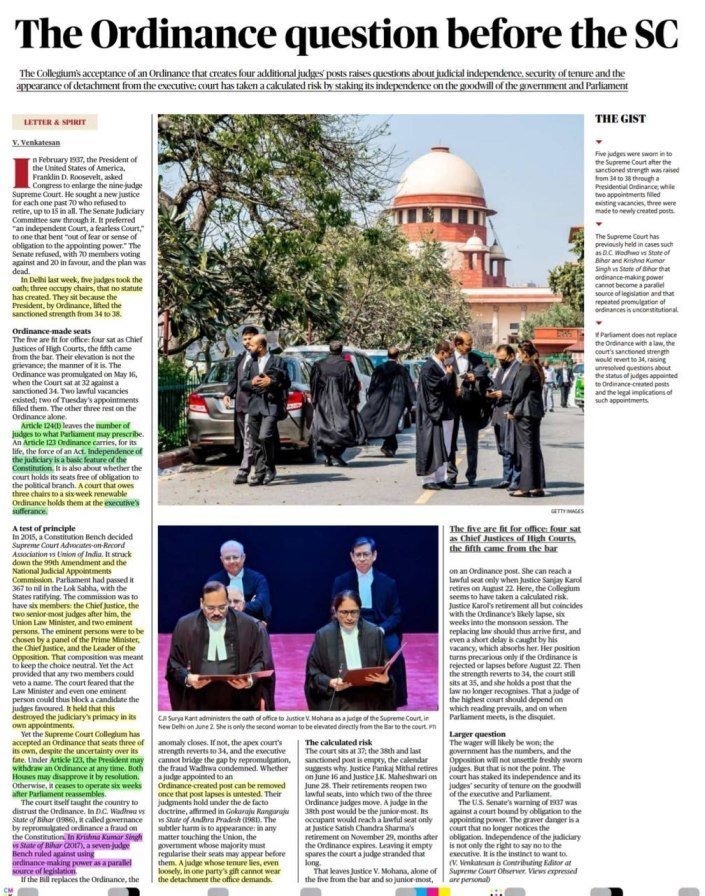
The swearing-in of five new judges to the Supreme Court has triggered a constitutional debate because three of them were appointed to newly created judicial posts that exist due to a Presidential Ordinance increasing the Court’s sanctioned strength from 34 to 38 judges. The issue has raised concerns regarding judicial independence, security of tenure, and the judiciary’s relationship with the executive.
Key Highlights
On 16 May 2025, a Presidential Ordinance increased the sanctioned strength of the Supreme Court from 34 to 38 judges by creating four additional posts.
Five judges were sworn in to the Supreme Court. Two appointments filled existing vacancies, while three appointments were made against the newly created posts.
Under Article 123, the President may promulgate an Ordinance when Parliament is not in session. However, an Ordinance is temporary and must be approved by Parliament within the constitutionally prescribed period.
The Supreme Court Collegium accepted appointments to the Ordinance-created posts even though the continuance of those posts depends upon subsequent parliamentary approval.
The Supreme Court has consistently held that the Ordinance-making power is an exceptional legislative mechanism and not a parallel source of law-making. Important judgments include: ◊ D.C. Wadhwa v. State of Bihar (1987) ◊ Krishna Kumar Singh v. State of Bihar (2017)
The article argues that acceptance of appointments to posts created through a temporary Ordinance may create an appearance of dependence on executive action, thereby raising questions about judicial autonomy.
Constitutional and Institutional Concerns
Judicial posts created through an Ordinance remain subject to parliamentary approval, making their permanence uncertain.
If Parliament does not replace the Ordinance with legislation, the sanctioned strength would revert to 34, creating uncertainty regarding the status of appointments made to the additional posts.
The situation raises concerns about the security of tenure of judges, a key element of judicial independence.
A judiciary that accepts appointments dependent on executive action may face criticism regarding its institutional detachment from the political branches.
The issue highlights the need to maintain a clear separation between the judiciary and the executive while ensuring adequate judicial capacity.
Larger Constitutional Question
The debate is not about the qualifications of the newly appointed judges. Rather, it concerns whether the judiciary should occupy positions whose legal existence depends on a temporary executive measure awaiting legislative approval. The controversy underscores the importance of preserving judicial independence, institutional credibility, and constitutional propriety while addressing the growing need for more judges in the Supreme Court.
Conclusion
The Ordinance increasing the Supreme Court’s strength may help reduce judicial workload, but it also raises important constitutional questions. The episode highlights the need for court expansion through stable legislative processes rather than temporary executive measures, thereby safeguarding judicial independence, security of tenure, and public confidence in the judiciary.