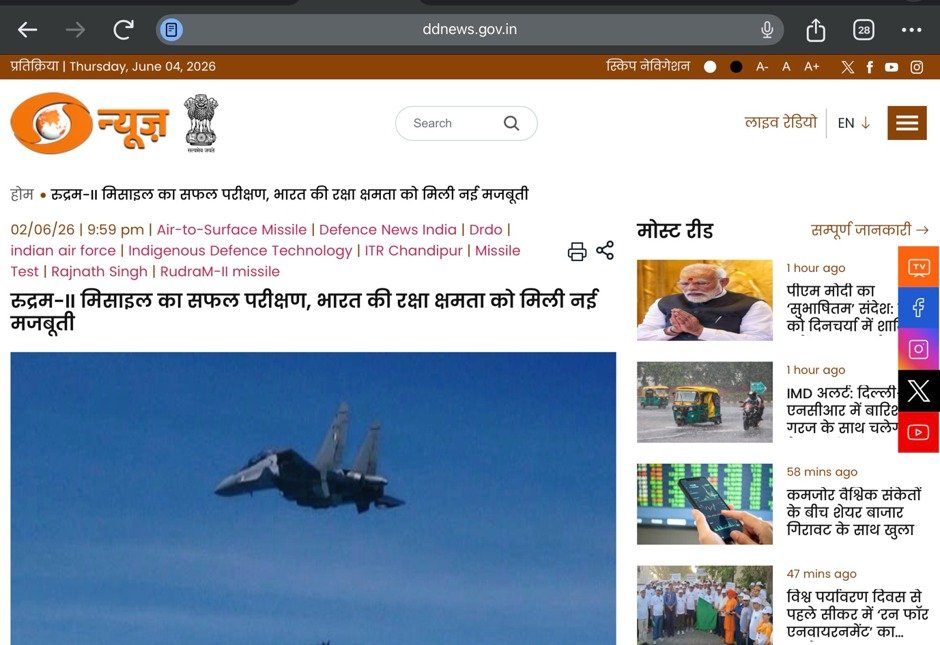
Developed by. - DRDO (lead lab: Research Centre Imarat, Hyderabad)
|
Parameter |
Details |
|
Type |
Air-to-Surface Anti-Radiation Missile |
|
Speed |
Mach 5.5 (hypersonic) |
|
Range |
300–350 km |
|
Warhead |
200 kg |
|
Launch Altitude |
3 km to 15 km |
Platforms & Strategic Significance
- The missile is being developed for the IAF's fleet of Su-30MKI and Dassault Mirage 2000 aircraft.
- It is slated to gradually replace the ageing Russian-origin Kh-31 anti-radiation missiles currently in service.
Comparison with Rudram 1
|
Feature |
RudraM-1 |
RudraM-II |
|
Speed |
Mach 2 |
Mach 5.5 |
|
Range |
250 km |
300–350 km |
|
Category |
Supersonic |
Hypersonic |
Anti-Radiation Missile -
- A missile that homes in on electromagnetic radiation emitted by enemy radar systems. It detects, tracks, and destroys radar antennas, air-defence networks, and communication infrastructure — allowing friendly aircraft to operate safely in hostile airspace.
Strategic Significance
- Gives IAF long-range SEAD (Suppression of Enemy Air Defences) capability indigenously — previously dependent on foreign systems.
- Replaces ageing Russian Kh-31 missiles — reduces import dependency.
- Can destroy radar stations, command & control centres, SAM sites from stand-off distances.
- At Mach 5.5, it is very difficult to intercept — high tactical advantage.
- Allows strike aircraft to degrade enemy air-defence networks before entering contested airspace.
Source:- DD News