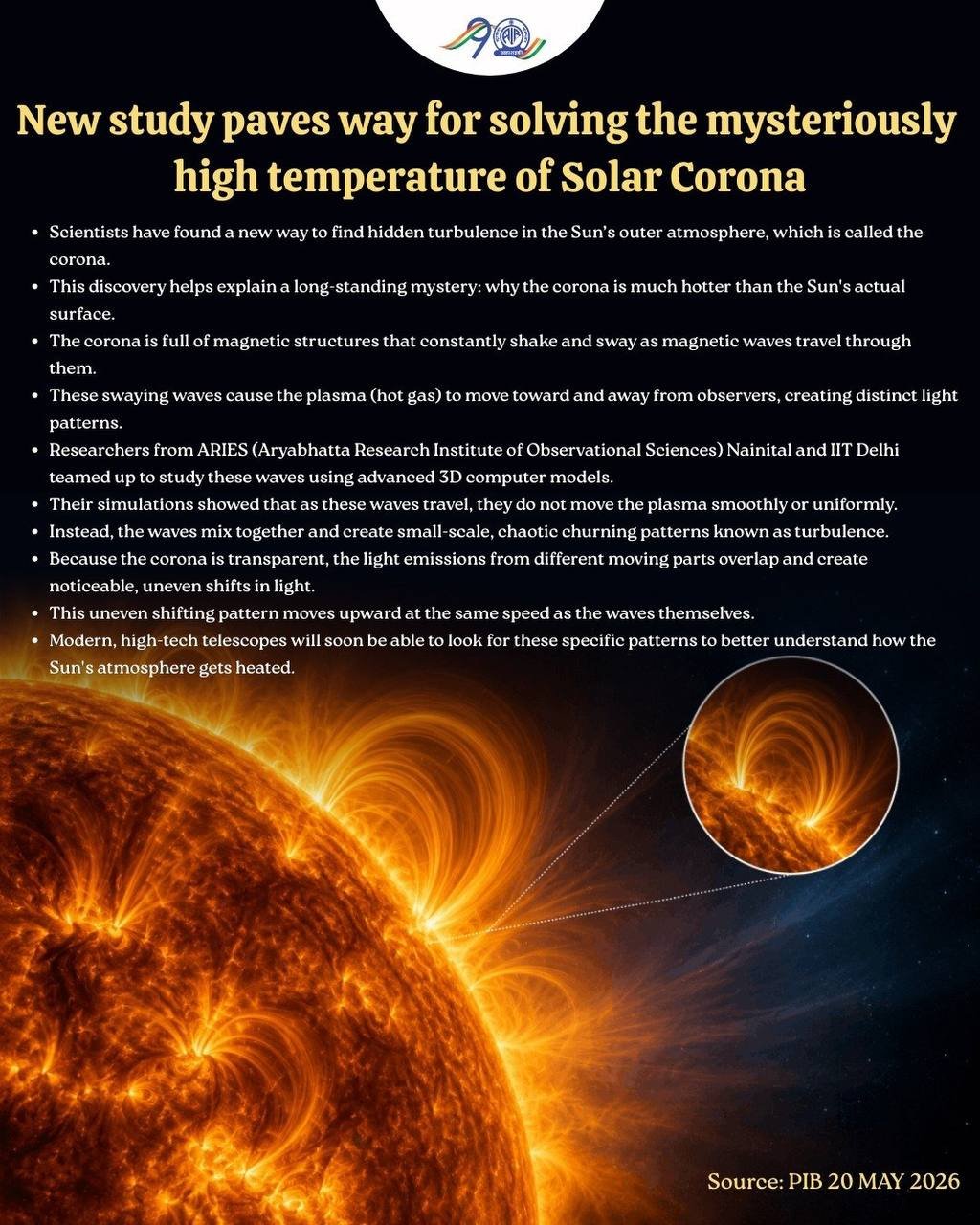
One of the greatest unsolved mysteries in solar physics has puzzled scientists for decades:
- Why is the Sun’s outer atmosphere, known as the corona, far hotter than its visible surface?
- A recent breakthrough by Indian researchers may finally provide an important clue to solving this “Coronal Heating Mystery.”
- Scientists from Aryabhatta Research Institute of Observational Sciences (ARIES) and Indian Institute of Technology Delhi have identified a new mechanism to detect hidden turbulence in the Sun’s corona, offering fresh insight into how the corona reaches temperatures of millions of degrees Celsius.
What is the Solar Corona?
- The corona is the outermost layer of the Sun’s atmosphere. It extends millions of kilometres into space and becomes visible during a total solar eclipse as a glowing white halo surrounding the Sun.
- What makes the corona extraordinary is its extremely high temperature:
- Corona → nearly 1–3 million °C
- Photosphere (Sun’s visible surface) → about 5,500 °C
- This creates a scientific paradox because, under normal conditions, temperature should decrease farther away from the heat source. However, the Sun’s outer atmosphere is vastly hotter than its surface.
This unexplained phenomenon is called the:
- Coronal Heating Problem
- Key Findings of the Research
- The study focused on the behavior of magnetohydrodynamic (MHD) waves inside the corona.
- These waves travel through magnetic structures present in the Sun’s plasma-filled atmosphere. Scientists discovered that:
- the waves do not move plasma uniformly,
- interactions among waves create irregular plasma motions,
- and these interactions generate small-scale turbulence.
⇒ Using advanced 3D simulations, researchers observed that this turbulence can convert wave energy into heat.
In simple terms:
- Turbulence acts like a hidden energy transfer mechanism that heats the corona.
- This finding strengthens the theory that turbulent dissipation of wave energy could be responsible for the Sun’s superheated outer atmosphere.
What is Turbulence?
- Turbulence refers to chaotic and irregular motion in a fluid or plasma that enhances mixing, energy transfer and dissipation.
- In the solar corona, turbulent plasma motions may continuously convert magnetic and wave energy into thermal energy, thereby increasing temperature.
Why is this Discovery Important?
The discovery is significant because it:
- provides a possible explanation for the long-standing coronal heating mystery,
- improves understanding of solar physics,
- enhances knowledge of space weather and solar storms,
- helps scientists better understand Sun-Earth interactions,
- and may improve prediction of geomagnetic disturbances affecting satellites and communication systems.
⇒ The findings may also guide future observations using next-generation high-resolution solar telescopes.
⇒ Scientists hope that future missions and observatories will detect these turbulence signatures directly and validate the theory.
Role of Aditya-L1
⇒India’s first dedicated solar mission, Aditya-L1, is expected to play an important role in studying such solar phenomena.
The mission studies:
- the solar corona,
- solar wind,
- solar magnetic activity,
- space weather.
⇒ Positioned at the Lagrange Point L1, Aditya-L1 provides continuous observations of the Sun without interruptions caused by eclipses or Earth’s shadow.
⇒ The mission strengthens India’s growing role in global space and solar research.
Conclusion
- The new findings by Indian researchers mark an important step toward solving one of astronomy’s biggest mysteries. By uncovering the role of hidden turbulence and wave interactions in the solar corona, the study deepens scientific understanding of how the Sun functions.
- Beyond pure scientific curiosity, such discoveries are crucial because solar activity directly influences Earth’s technological systems, satellites, communication networks and space weather conditions.