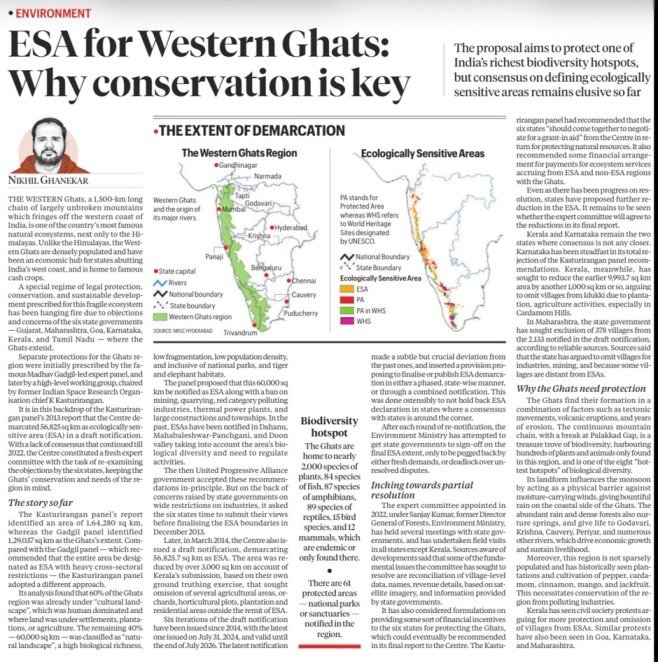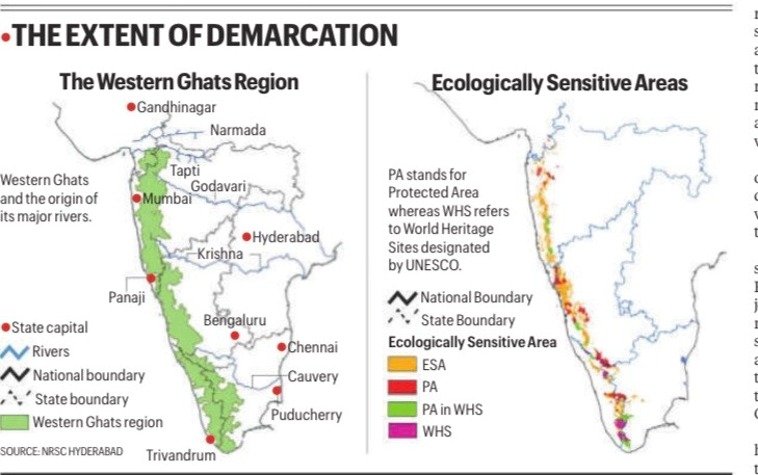
Source of image – Indian express
|
Feature |
Detail |
|
Length |
1,500 km along India's west coast |
|
States covered |
Gujarat, Maharashtra, Goa, Karnataka, Kerala, Tamil Nadu |
|
Biodiversity rank |
One of 8 "hottest hotspots" of biological diversity globally |
|
Break point |
Continuous mountain chain with a break at Palakkad Gap |
|
UNESCO status |
Contains World Heritage Sites (WHS) |
WESTERN GHATS NEED PROTECTION -
Ecological significance-
- Home to nearly 2,000 species of plants, 84 fish, 87 amphibians, 89 reptiles, 15 birds, 12 mammals many endemic (found only here).
- Influences monsoon acts as physical barrier trapping moisture-carrying winds → bountiful rainfall on coastal side.
- Source of major rivers: Godavari, Krishna, Cauvery, Periyar and numerous others drives economic growth and livelihoods.
- Nurtures springs and dense forests.
Human context-
- Not sparsely populated — historically has plantations of pepper, cardamom, cinnamon, mango, coffee.
- Home to famous cash crops.
- Economic hub for west coast states.
ESA notification entails - Ban on mining, quarrying, red-category polluting industries, thermal power plants, large constructions and township.Regulated activities in notified area.
COMMITTEE REPORTS
01. Gadgil Committee (Western Ghats Ecology Expert Panel)
- Identified 1,29,037 sq km as the Ghats' extent.
- Recommended entire area be designated ESA with heavy cross-sectoral restrictions.
- Considered more conservation-heavy; faced strong state opposition.
02. Kasturirangan Panel (High-Level Working Group)
- 6 states should negotiate for grant-in-aid from Centre in exchange for protecting natural resources , financial arrangement for ecosystem services payments.
- Constituted after states objected to Gadgil recommendations Identified 1,64,280 sq km total Ghats region.
- Found 60% already under "cultural landscape" (human-dominated settlements, plantations, agriculture).
- Remaining 40% (60,000 sq km) "natural landscape" with high biological richness, low fragmentation, low population density proposed as ESA.
- Proposed 56,825 sq km notified as ESA.
- Recommended ban on mining, quarrying, polluting industries, thermal power plants, large constructions.
03.SANJAY KUMAR EXPERT COMMITTEE (2022–Present)
- Held several meetings with all state governments.
- Field visits in all states except Kerala.
- Key issues being resolved:
- Village-level data reconciliation (names, revenue details, satellite imagery).
- Financial incentives for the 6 states for protecting the Ghats.