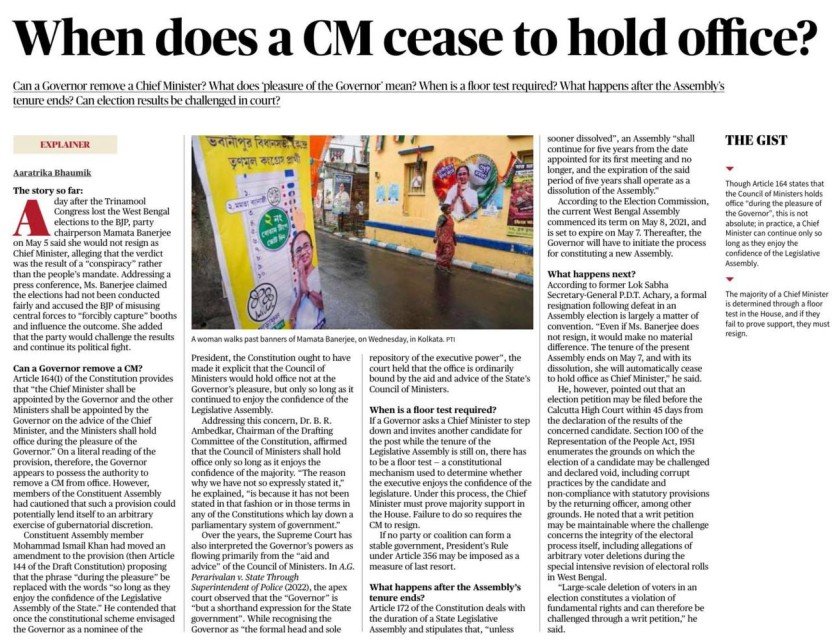
Constitutional Basis:-
- Article 164(1) of the Constitution provides that the Chief Minister (CM) and the Council of Ministers hold office “during the pleasure of the Governor”. However, in a parliamentary system, this pleasure is not absolute and is conditioned by the confidence of the Legislative Assembly.
Meaning of the ‘Pleasure of the Governor’
- The Governor cannot arbitrarily remove a Chief Minister.
- A Chief Minister continues in office as long as they enjoy the confidence of the majority in the Legislative Assembly.
- The Governor ordinarily acts on the aid and advice of the Council of Ministers under Article 163.
Circumstances in which a Chief Minister ceases to hold office:-
A Chief Minister may cease to hold office in the following situations:-
- Loss of majority support in the Legislative Assembly
- Failure to prove majority in a floor test
- Resignation from office
- Dissolution or expiry of the term of the Legislative Assembly
- Death or disqualification from membership of the legislature
Floor Test and Majority:-
- A floor test is the constitutional mechanism used to determine whether the government enjoys majority support in the House.
- When doubts arise regarding the majority of the government, the Governor may direct the Chief Minister to prove majority on the floor of the Assembly.
- If the Chief Minister fails to secure majority support, the government must resign.
Role of the Governor:-
- The Governor may require a floor test where there is credible doubt regarding the government’s majority.
- The Governor cannot dismiss a ministry solely on subjective satisfaction.
- The Governor’s actions are subject to constitutional limitations and judicial review.
Supreme Court Principles:-
The Supreme Court has consistently held that:
- The majority of a government should ordinarily be tested on the floor of the House.
The discretionary powers of the Governor are limited. - Constitutional morality and democratic principles must guide gubernatorial actions.
Expiry of the Legislative Assembly:-
- Under Article 172, a State Legislative Assembly normally continues for five years unless dissolved earlier.
On expiry or dissolution of the Assembly, the Council of Ministers, including the Chief Minister, ceases to hold office. - A caretaker government may continue temporarily until a new government is formed.
Challenge to Election Results:-
- Election results may be challenged before the High Court under the Representation of the People Act, 1951 on grounds such as:
- Corrupt electoral practices
- Electoral irregularities
- Violation of statutory provisions
Relevant Constitutional Provisions:-
- Article 163 – Aid and advice to the Governor
- Article 164 – Appointment and tenure of Chief Minister and Council of Ministers
- Article 172 – Duration of State Legislature
- Article 356 – President’s Rule
Conclusion:-
- In the Indian parliamentary system, the continuance of a Chief Minister in office ultimately depends on the confidence of the Legislative Assembly and not merely on the formal pleasure of the Governor. Floor tests and judicial scrutiny act as safeguards for democratic legitimacy and constitutional governance.