Introduction
- India's clean energy transition has gained remarkable momentum over the past decade, with solar energy emerging as the cornerstone of the country's renewable energy strategy. Solar power now contributes nearly 30% of India's installed electricity capacity, and the country added more than 50 GW of solar capacity in the last few years.
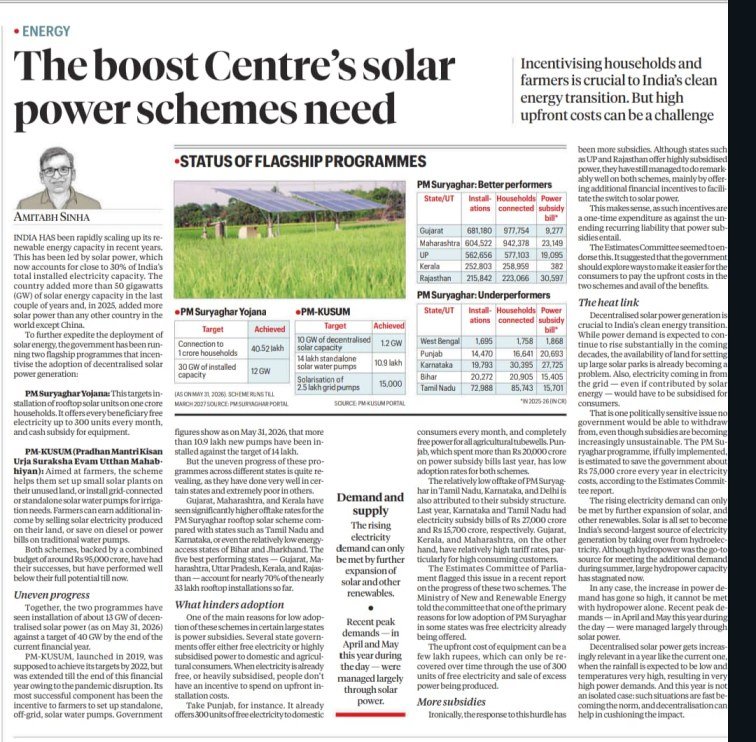
- To accelerate adoption further, the Government of India launched two flagship programmes—PM Surya Ghar: Muft Bijli Yojana and PM-KUSUM. While both schemes have shown encouraging results, their progress remains uneven across states, highlighting the need for stronger policy support and targeted incentives.
India's Solar Growth Story
- India has become one of the fastest-growing solar energy markets globally.
Key Achievements
- India crossed 250 GW of renewable energy installed capacity in 2026.
- Solar energy accounts for more than 150 GW of installed capacity.
- India became the third-largest renewable energy producer in the world after China and the United States.
- Renewable sources now contribute significantly to India's electricity generation mix.
- India has already achieved the milestone of 50% installed electricity capacity from non-fossil fuel sources, years ahead of its 2030 target.
⇒ This rapid expansion is central to India's commitment under the Paris Agreement and its updated Nationally Determined Contributions (NDCs).
PM Surya Ghar Yojana: Rooftop Solar for Households
- Launched to promote rooftop solar installations, PM Surya Ghar aims to reduce electricity bills and increase household participation in clean energy generation.
Major Objectives
- Connect 1 crore households with rooftop solar systems.
- Create 30 GW of rooftop solar capacity.
- Provide subsidies to reduce installation costs.
- Enable households to generate their own electricity and sell surplus power to the grid.
Progress So Far
According to recent data:
- More than 40 lakh households have been connected.
- Around 12 GW capacity has been installed.
- States such as Gujarat, Maharashtra, Uttar Pradesh, Kerala and Rajasthan have emerged as top performers.
PM-KUSUM: Solarising Agriculture
- The PM-KUSUM scheme focuses on the agricultural sector and aims to make farming more energy-efficient and sustainable.
Key Components
- Installation of standalone solar pumps.
- Solarisation of existing agricultural pumps.
- Decentralised solar power generation in rural areas.
- Additional income opportunities for farmers through power generation.
Progress
- Over 10 lakh solar pumps have been installed.
- Decentralised solar generation capacity continues to expand.
- Several states have successfully integrated solar irrigation systems into their agricultural infrastructure.
Why Adoption Remains Uneven
- Despite impressive achievements, adoption rates vary significantly across states.
- Better Performing States
- Gujarat
- Maharashtra
- Rajasthan
- Uttar Pradesh
- Kerala
- Relatively Slower States
- West Bengal
- Bihar
- Punjab
- Karnataka
- Tamil Nadu (in rooftop solar adoption relative to potential)
- This disparity highlights structural and policy challenges that need immediate attention.
Major Challenges Hindering Adoption
1. High Upfront Installation Costs
- The biggest barrier for households and farmers remains the initial investment required for solar systems.
- Although subsidies reduce costs, many consumers still find the upfront expenditure difficult to afford.
2. Free or Highly Subsidised Electricity
- In several states, consumers already receive free or heavily subsidised electricity.
As a result:
- Households have little incentive to invest in rooftop solar.
- Farmers see limited financial benefits in switching to solar pumps.
- Adoption rates remain lower despite available subsidies.
3. Lack of Awareness
- Many potential beneficiaries are unaware of:
- Available subsidies
- Application procedures
- Long-term savings
- Net metering benefits
⇒ Awareness gaps continue to restrict large-scale adoption.
4. Financing Constraints
- Access to affordable financing remains limited, particularly in rural areas.
- Many households and small farmers struggle to secure low-interest loans for solar installations.
5. Administrative Delays
- Approval processes, subsidy disbursement delays, and utility-level bottlenecks often discourage consumers from adopting solar systems.
Why Decentralised Solar Matters
- India's future energy security increasingly depends on decentralised renewable energy systems.
Key Benefits
- Reduced Transmission Losses
- Electricity is generated near the point of consumption, reducing transmission losses.
- Lower Peak Demand Pressure
- Rooftop solar helps reduce pressure on the grid during periods of high electricity demand.
- Energy Access
- Remote and rural areas gain reliable access to electricity.
- Farmer Empowerment
- Farmers can generate additional income by selling surplus electricity.
- Climate Benefits
- Solar power reduces dependence on fossil fuels and lowers carbon emissions.
Link with India's Updated NDCs
- India's recently updated climate commitments place strong emphasis on expanding renewable energy and reducing emissions intensity.
- Solar energy plays a critical role in achieving:
- Higher non-fossil fuel electricity generation.
- Reduced carbon emissions.
- Energy security.
- Sustainable economic growth.
- Climate-resilient development.
♦ The success of PM Surya Ghar and PM-KUSUM will directly influence India's ability to meet its 2030 climate targets.
What More Needs to Be Done?
- Increase Financial Incentives
- Additional incentives may be required in states where electricity is already heavily subsidised.
- Expand Affordable Financing
- Dedicated solar credit lines and low-interest loans should be made available.
- Improve Awareness Campaigns
- Large-scale public outreach can improve participation.
- Strengthen Distribution Infrastructure
- Grid modernisation and better net-metering systems are essential.
- Encourage State-Level Innovation
- States should design customised solar policies based on local conditions.
Conclusion
- India's solar transition has made remarkable progress, but flagship schemes such as PM Surya Ghar and PM-KUSUM have yet to realise their full potential. While the country is rapidly expanding renewable energy capacity, challenges such as high upfront costs, uneven implementation, and subsidy distortions continue to slow adoption.
- Strengthening incentives, improving financing access, and enhancing policy coordination between the Centre and states can unlock the next phase of India's solar revolution. As electricity demand continues to rise and climate commitments become more ambitious, expanding decentralised solar power will remain essential for India's energy security, economic growth, and sustainable development.