SHANTI Act, 2025
- Nuclear power contributed only around 3% of India's electricity generation.
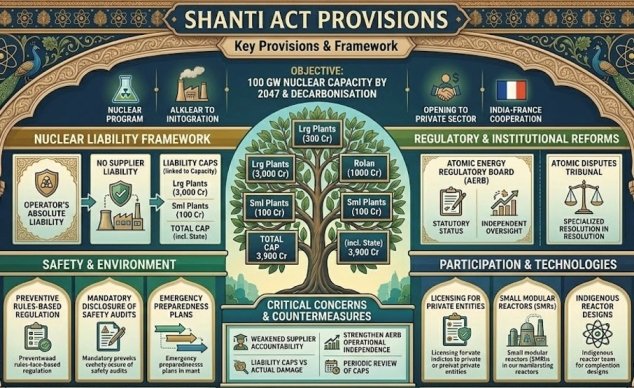
- The government has set a target of 100 GW nuclear capacity by 2047, including at least five indigenous Small Modular Reactors (SMRs) by 2033. Current installed capacity is close to 9 GW, requiring investment of over ₹19 lakh crore not feasible in the public sector alone.
- Old laws (1962, 2010) were restrictive and deterred private/foreign investment.
Two laws are replaced by shanti act –
- Atomic Energy Act, 1962- Regulated atomic energy; empowered govt for peaceful use; kept sector under strict state control.
- Civil Liability for Nuclear Damage (CLND) Act, 2010 -Introduced no-fault liability regime; provid compensation framework after nuclear incidents.
Key Provisions –
01. Private Sector Entry -
- Licences can now be granted to Indian private companies, government–private joint ventures, and other entities expressly permitted by the Centre (excluding foreign-incorporated companies).
- Permitted activities include building, owning, operating, and decommissioning nuclear plants, and fabrication, transport, trade, and storage of nuclear fuel.
- FDI cap in nuclear power projects restricted to 49%.
02. State Monopoly Retained Over Sensitive Areas -The Bill retains government control over sensitive areas such as nuclear fuel production, heavy water manufacturing, and radioactive waste management, safeguarding national security and non-proliferation commitments.
3. Graded Liability Structure
Operator liability is linked to plant size
| Plant Capacity | Operator Liability |
| CapBelow 150 MW | ₹100 crore |
| 1,500–3,600 MW | ₹1500 crore |
| Above 3,600 MW | ₹3000 crore |
- Total liability cap is 300 million SDRs (roughly ₹3,900 crore). The Centre is liable for nuclear damage beyond the operator's cap and can assume full liability for a non-government installation if in the public interest.
04. Supplier Liability Removed –
- Under the old CLNDA Section 17, operators could seek compensation from suppliers if an accident resulted from defective equipment or supplier negligence. The SHANTI Act omits this provision, shielding equipment vendors from long-term liability.
- Operator recourse against suppliers is now allowed only when expressly provided in a written contract or when an incident is due to an act or omission with intent to cause nuclear damage.
05. Regulatory Reforms
- Grants statutory status to the Atomic Energy Regulatory Board (AERB), making it accountable to Parliament.
- Designates the Appellate Tribunal for Electricity (APTEL) to hear nuclear disputes.
- Penalty for violations of the Act capped at a maximum of ₹1 crore.
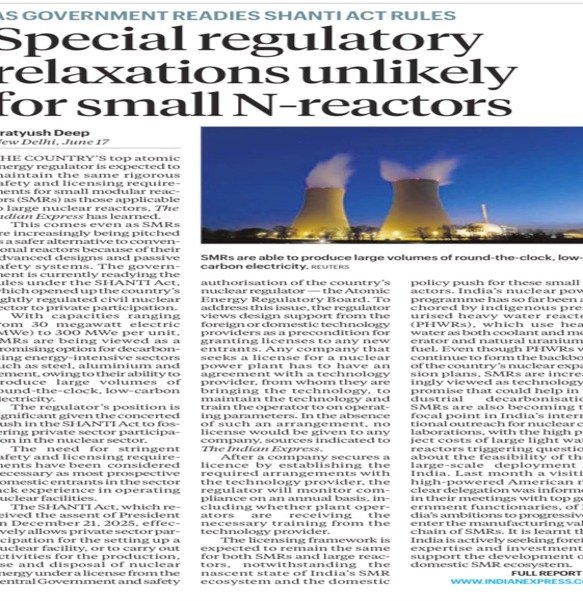
6. Small Modular Reactors (SMRs) -Institutionalises the ₹20,000 crore 'Nuclear Energy Mission' to deploy indigenous 220 MW Small Modular Reactors (SMRs) called Bharat SMRs.
07. Patent Reform- Amends Section 4 of the Patents Act, 1970 to allow patenting of peaceful nuclear energy inventions.
08. RTI Exemption (Controversial) -Section 39 overrides the RTI Act by permanently exempting "restricted" nuclear information, eliminating appeals and public-interest review, raising transparency concerns.
Concerns & Criticisms -
- Supplier Immunity - Removes accountability for defective equipment; creates moral hazard.
- Low Liability - Cap₹3,000 crore may be insufficient for victims and environmental remediation post-accident .
- Regulatory Independence- AERB appointments still vest significant influence with Centre and Atomic Energy Commission.
- RTI Exemption - Blanket secrecy on "restricted" information undermines transparency.
- SMR Viability - Small modular reactors remain largely untested and may have higher per-unit capital costs.
- Insurance Asymmetry -Operators must maintain insurance, but the Centre's own nuclear installations are exempted.
Way Forward -
- Strengthen AERB's independence through transparent, parliamentary appointments.
- Revisit supplier liability provisions to align with Vienna Convention standards.
- Create robust public disclosure norms for safety data while protecting genuine national security interests.
- Fast-track indigenous SMR development under DAE to reduce import dependence.
- Align nuclear expansion with India's NDC targets and Net Zero 2070 commitment.
Mains question-
Q.)1.Critically analyse the role of private sector participation in India's nuclear energy sector in light of the SHANTI Act, 2025?