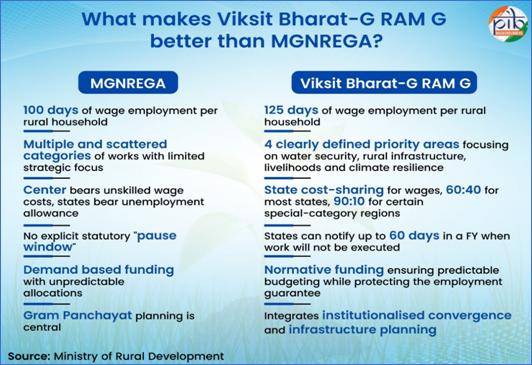
- Viksit Bharat - G RAM G Act has been introduced to replace the Mahatma Gandhi National Rural Employment Guarantee Act (MGNREGA) 2005.
- Objective: The bill seeks to establish a rural development framework alinged with the national vision of Viksit Bharat@2047.
- Passed by Lok Sabha: December 18, 2025;
- Passed by Rajya Sabha: December 19, 2025;
- Presidential assent: Thecember 21, 2025
- Notified by the Government of India: May 11, 2026
- Act Effective From: July 1, 2026
Financial Provision: The Central Government has allocated an amount of ₹95,692.31 crore for the financial year 2026-27.
Key legal provisions:
- Employment Guarantee: Provision of a legal guarantee of 125 days of wage-based employment per financial year for every adult member of a rural household willing to undertake unskilled manual work.
- Timely Wage Payment: This Act mandates that wages be paid on a weekly basis or in any case, within fifteen days of the completion of the work.
- Core Planning Framework: Under the new Act, planning is driven by the Viksit Gram Panchayat Plans (VGPPs).
-
- Gram Panchayat Responsibility: The Gram Panchayats are the primary bodies responsible for preparing these VGPPs.
- Integration with National Platforms: To ensure efficiency and avoid duplication, these plans are linked with the National Spatial Platform, which includes PM Gati Shakti.
- Infrastructure Stack: All planned activities must be integrated with the Viksit Bharat National Rural Infrastructure Stack, ensuring that local projects contribute to broader national development goals.
- Priority Areas for Planning:
1. Water Security
2. Rural Infrastructure
3. Livelihood Infrastructure
4. Extreme Weather Protection (Climate Resilience)
- Relaxation in agricultural peak season: State governments may notify a maximum period of 60 days per year during which labourers will not be required to work.
- Centrally sponsored scheme: The funding will be shared 60:40 between the central and state governments, except for the North-Eastern and Himalayan states where the ratio will be 90:10.
- There is a provision for 100% central funding for Union Territories without legislatures.
- Strengthening Administrative Capacity: The maximum limit for administrative expenses has been increased from 6% to 9%.
- Normative Allocation: The Central Government will release Normative allocations based on predetermined objective parameters . The state government will be responsible for any expenditure exceeding the standard allocation.
- Special Exemptions: In cases of natural disasters or other extraordinary circumstances, based on the recommendation of the State Government, the Central Government may provide special exemptions as needed.
- Transparency and Accountability: Transparency will be ensured through biometric and spatial technology-based planning, mobile/dashboard monitoring, weekly public disclosure, and social audits.
- Unemployment Allowance: If employment is not provided within the stipulated period, state governments will be obligated to provide unemployment allowance after 15 days, as per the Act. This shall be paid by the State Government at a rate of at least one-fourth of the notified wage for the first 30 days of the financial year, and at half the wage rate for the remaining period.
- Financial Provisions: The Central Government has allocated a sum of ₹95,692.31 crore for the financial year 2026-27.
- Timeline for Employment Availability: Employment must be provided within 15 days from the date of application. In the event of failure to do so, the worker shall have a legal right to receive an unemployment allowance.
- Payment Method: Wages are transferred directly into the workers' bank or post office accounts through Direct Benefit Transfer (DBT).
- Wage Payment: Wages shall be paid on a weekly basis or within 15 days of the closure of the Muster Roll.
- Compensation: If wages are not paid within the stipulated timeframe, workers shall be entitled to receive compensation for the delay in accordance with the provisions of the Act.
- Workplace Amenities: The workplace must mandatorily provide clean drinking water, a shaded area for rest, a crèche (childcare facility), and a first-aid kit.
- Work Area Limit: Employment shall be provided within a radius of 5 kilometers from the worker's residence. If employment is provided at a distance exceeding this limit (but still within the same Block), workers shall be paid an additional 10 percent of the wage rate to cover transportation and subsistence expenses.
-
Role of Gram Panchayats: This includes the registration of households, receiving applications for employment, execution of works, maintenance of records related to the scheme, and the preparation of Village Panchayat Plans (VGPPs), among other responsibilities.
-
Material Costs: Expenditure on the material component is capped at a maximum of 40 percent of the total budget at the district level.
- Institutional monitoring : A Central Gramin Rozgar Guarantee Council and State Gramin Rozgar Guarantee Councils will be constituted for reviewing and effectively implementing the Act. The steering committees formed at the central and state levels will make recommendations on various issues, including standard allocation.
- Wage Rate Determination: The Central Government will notify the new rates; the current MGNREGA rates will remain in effect until the new rates are implemented.
- State Schemes: Each state will notify its scheme within six months of the date the Act comes into force.