Ans.
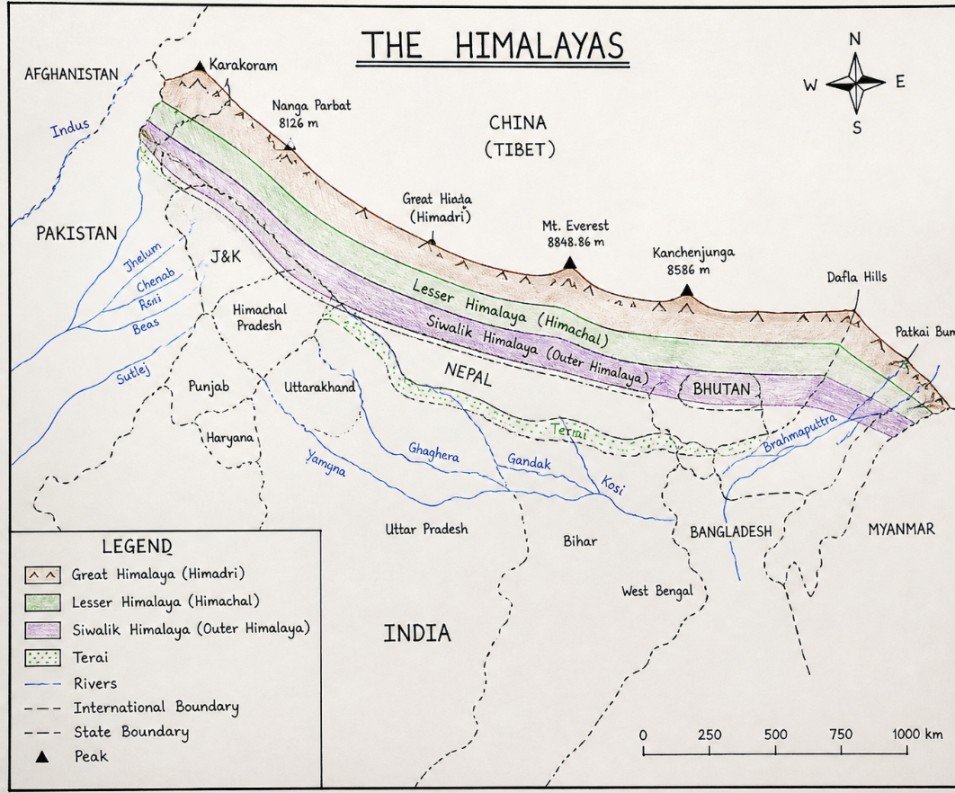
The Himalayas are a young fold mountain system with distinct and well-defined geographical features:
1. Three Parallel Ranges:
Great Himalayas (Himadri):
- The northernmost and highest range with an average elevation of about 6000–6100 m. It is the most continuous range and forms the core of the Himalayas, mainly composed of granite. It contains the highest peaks like Mount Everest and Kanchenjunga, and major glaciers such as Gangotri Glacier and Yamunotri Glacier.
Middle Himalayas (Himachal):
- Located south of Himadri, this range consists of highly compressed and altered rocks. It is known for its beautiful valleys and hill stations, including Kashmir Valley and Kangra Valley.
Shivaliks:
- The outermost and lowest range, formed of unconsolidated sediments brought down by rivers. These hills are discontinuous and prone to erosion.
2. Syntaxial Bends:
- The Himalayas take sharp bends at both ends:
-Western end near Nanga Parbat
-Eastern end near Namcha Barwa
3. Glaciers and Passes:
- The region has many glaciers and important mountain passes such as Zoji La and Shipki La, which facilitate connectivity.